
TL;DR
A weight-distribution (WD) hitch transfers tongue weight from your truck's rear axle forward to its front axle and back to the trailer's axles, restoring level ride and proper steering. Sway control is a separate function — some WD hitches integrate it, some don't. Match the spring-bar rating to your real loaded tongue weight, not the trailer's brochure dry weight, and you'll do better than 80% of buyers without spending top-shelf money.
The dealer's weight-distribution hitch upsell is one of the most predictable conversations in RV sales. You sign for the trailer. The finance manager hands you off to the parts department. Parts hands you a quote with a $1,200 hitch on it. Maybe a $1,400 hitch with "integrated sway control." Sometimes a $1,800 hitch with friction bars and torsion springs and seventeen adjustment knobs.
And almost nobody in that chain explains what a weight-distribution hitch actually does, or how to size one, or why the $1,200 model and the $300 model might both do the job just fine. They explain that you need one. They explain that this one is "better." And they ring you up before you've had a chance to think about it.
This is the post we'd give our past selves before we walked into that conversation in 2017. It won't make you a hitch installer. But it'll make sure that when you sit down at the parts desk, you know what questions to ask and what answers should make you walk away.
What a weight-distribution hitch actually does
Hitch up a 700-lb tongue-weight travel trailer to your truck with a plain ball mount and look at it from the side. The back of the truck sags. The front of the truck rises. Steering feels light. Headlights point at the trees. Braking distance grows. This is the physics: 700 lbs hanging behind the rear axle acts like a kid on the end of a see-saw — it pushes the back down and pries the front up.
A weight-distribution hitch uses two long spring bars that mount to the trailer's A-frame and apply leverage back through the hitch head. The result is that some of that 700-lb tongue load gets transferred forward to the truck's front axle and back to the trailer's axles, instead of all dumping on the truck's rear axle. The truck levels out. The front axle gets back to roughly its empty-trailer ride height. Steering and braking come back. Headlights point at the road.
It does not add payload to your truck. The total tongue weight is still the total tongue weight, and it still counts against your truck's payload capacity (see our tow vehicle math post). What WD does is redistribute that load across more axles so that no single axle is overloaded and the truck rides correctly.
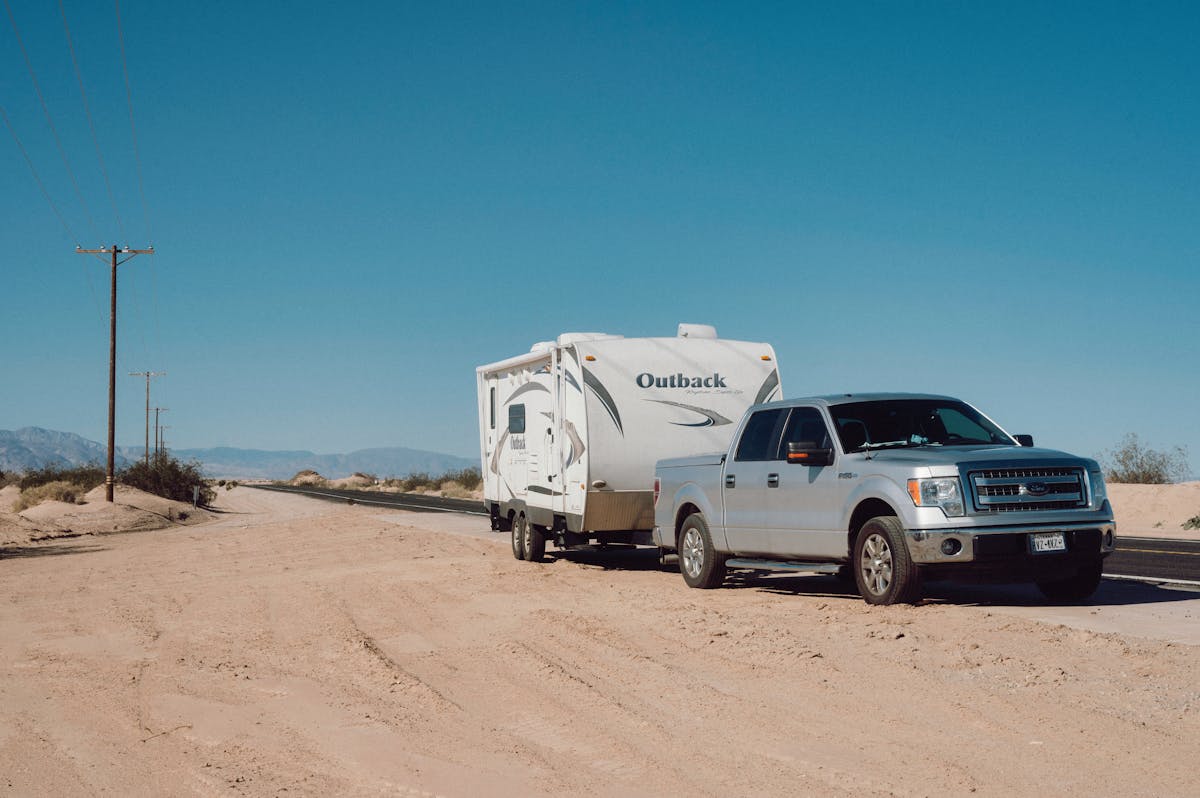
The threshold most owners use: if your tongue weight is more than about 500 lbs, or if your truck noticeably squats when you hook up, you want a WD hitch. Below that, plain ball-mount towing can be fine. Above that, WD becomes important — and over about 1,000 lbs of tongue weight, it stops being optional in any practical sense.
Sway control: a separate problem
Sway is what happens when the trailer starts oscillating side-to-side behind the truck — usually triggered by a crosswind, a passing semi, or a sudden steering input. Once it starts, it can amplify on its own and become a runaway situation. This is the dominant failure mode in trailer wrecks, and it's why "sway control" gets its own marketing line.
Some weight-distribution hitches integrate sway control directly into the spring-bar geometry. Equal-i-zer is the classic example — its L-brackets create friction that resists side-to-side trailer motion. Reese's Dual Cam and Husky's Centerline use cam mechanisms that nudge the trailer back to center if it starts to drift. Andersen No-Sway uses ball-and-chain geometry with a friction surface. Hensley and ProPride use pivot-point geometry that essentially eliminates sway through engineering rather than friction.
Other WD hitches don't include sway control at all — you bolt on a separate friction-bar sway controller (a single bar connecting trailer to truck with a friction puck inside). That works fine for shorter, lighter trailers, especially below about 24 feet.
The rough rule we use:
- Trailer under 24 feet, tongue weight under 600 lbs: any WD hitch + a friction bar sway controller is usually enough.
- Trailer 24–32 feet: integrated sway control (Equal-i-zer, Reese Dual Cam, Husky Centerline, etc.) is worth the modest price bump.
- Trailer 32+ feet, or first-time tow vehicle: a hitch with serious anti-sway engineering (Hensley, ProPride) is worth considering if the budget allows. Otherwise, integrated sway in a quality mid-tier hitch is the practical choice.
The honest version
Sway control matters more than brand loyalty. A $300 Husky Centerline with sway built in will out-perform a $1,000 hitch without sway every time. Don't let anyone sell you a "deluxe" WD hitch that doesn't include sway control just because it has shinier hardware.
Sizing the spring bars: the number that matters
Every WD hitch sells in spring-bar weight ratings. You'll see numbers like 600 lb, 800 lb, 1,000 lb, 1,200 lb, 1,400 lb. These ratings correspond to the tongue weight the bars are designed to handle, plus typically the weight of the cargo you put in the front of your truck.
Here's the rule: the spring-bar rating should be slightly higher than your real loaded tongue weight. Not the dry tongue weight on the trailer spec sheet. Not half of the trailer's GVWR. Not what the dealer told you. The actual tongue weight when your trailer is loaded for travel — water, propane, food, gear, and all.
The most common mistake: spec'ing the bars based on dry tongue weight from the brochure. Dry tongue weight on a 7,500-lb GVWR trailer might be 650 lbs. Loaded for a trip, that same trailer can have 950–1,100 lbs of tongue weight, especially if the freshwater tank is ahead of the axles and you put bikes on the A-frame rack.
If you bought 800-lb bars based on that 650-lb dry number, your bars will be overworked — too much deflection, harder to lift the trailer's A-frame, more wear on the hitch head and chains, and less of the tongue weight actually getting redistributed. The hitch will work, but it'll feel saggy and the truck won't come back to level.
Conversely, if you over-spec — putting 1,400-lb bars on a 600-lb-tongue trailer — the bars will be too stiff, the truck will feel jarred over every bump, and the trailer's A-frame can take more flex than it's designed for.
The sizing target: bar rating roughly 80–110% of your loaded tongue weight. So for 950 lbs of loaded tongue weight, 1,000-lb bars are right in the pocket. For 700 lbs of loaded tongue weight, 800-lb bars are right. Most brands publish a recommended range; honor it.
Getting your real loaded tongue weight
If you're guessing at tongue weight, you're guessing at hitch size. There are three ways to actually measure it:
- Tongue weight scale. Sherline makes the classic version — a small bottle-jack-style scale you put under the coupler. It reads tongue weight directly. $100-ish. Worth owning.
- Bathroom scale + lever method. Old-school technique that works if you have a sturdy beam, a bathroom scale, and a few cement blocks. Plenty of YouTube tutorials. Free if you already have the scale.
- CAT scale split-weigh. Pull onto a CAT scale with the trailer attached, get the truck's loaded rear axle weight. Disconnect the trailer (level it on jacks), pull the truck back on the same axle. The difference, with a small adjustment for the hitch hardware weight, is your tongue weight.
Method 1 is fastest. Method 3 gives you the most complete picture, because you also see how your axle loads change between unhitched and hitched, which is exactly what the WD hitch is supposed to correct.

The big-name brands at a category level
Here's a category-level overview, because brand wars on RV forums get exhausting and most owners do fine on any of the credible options. Going alphabetically:
Andersen No-Sway. Distinctive ball-and-chain design instead of traditional spring bars. Light weight, easy on-and-off, no greasing. Sway control comes from friction at the ball-and-chain interface. Works well in its rated range; some owners feel it's less aggressive at sway control than cam-based systems.
Blue Ox SwayPro. Spring-bar design with clamps at the trailer end and a chain-and-hook setup at the head. Integrated sway control. Quiet operation. Solid mid-tier choice.
Equal-i-zer. The benchmark integrated-sway WD hitch for decades. Spring bars with L-brackets that grip the trailer frame and apply friction-based sway resistance. Noisier than some (the L-brackets squeak; greasing helps). Extremely reliable. Lots of replacement parts available.
Hensley / ProPride. Engineered pivot-point design that essentially eliminates trailer sway through geometry rather than friction. Heavy, expensive, fiddly to set up the first time. Genuinely transformative for big trailers or long trips — but overkill for a 22-foot bunkhouse you take out twice a year.
Husky Centerline TS. Cam-based integrated sway control. Quiet, smooth, no greasing of friction surfaces required. Good value at the mid-tier price point.
Reese Dual Cam HP. Cam-based system, very effective sway control. Setup is more involved than friction-based systems. Reese also sells simpler trunnion-bar WD setups without integrated sway, intended to be paired with separate friction bars.
We've used Equal-i-zer-style and cam-based setups on different rigs over the years. Honestly, any of these, sized correctly and installed correctly, will do the job for most trailers under 32 feet. We're brand-agnostic about WD hitches in a way we're not about many other things.
The honest version
If your trailer is under 30 feet and you're not towing through the Rockies regularly, a mid-tier integrated-sway WD hitch in the $300–$500 range is a perfectly fine answer. You do not need a $1,200 hitch unless you have specific needs that justify it.
Setup: where most hitches go wrong
The hitch in the box is not the hitch on the road. Setup is where 80% of WD performance lives, and it's where dealer installations tend to fall short.
A correctly set up WD hitch will, when the truck and trailer are hooked up:
- Bring the truck's front-axle ride height back to approximately what it was before the trailer was attached (the "front axle drop" measurement). Typical target: restore at least 50–75% of the front-axle drop caused by the trailer.
- Bring the truck's rear-axle ride height up enough that the truck looks roughly level from the side.
- Leave the trailer level — not bow-up, not nose-down — when the spring bars are tensioned.
The variables you adjust to get there:
- Hitch head height (washers/shank position). Raises or lowers where the trailer coupler sits relative to the truck. Big effect on whether the trailer rides level.
- Hitch head tilt. Most heads have washers between the shank and the head that let you tilt the head forward or backward. Tilting backward increases spring-bar tension; forward decreases it.
- Chain length / hook position (Equal-i-zer style). Which link of the chain hooks to the L-bracket. Each link is roughly 1/3 inch of spring-bar lift.
- Bracket position on trailer A-frame. Distance from the coupler to where the L-brackets clamp. Affects effective lever arm.
The right way to set this up the first time is the "measure-adjust-measure" method: measure the truck and trailer ride heights with the trailer disconnected, hitch up without tension, write down the drops, then adjust the head and chains until you've restored most of the front-axle drop and the trailer is level. Plan an hour. Expect to do it twice before it's right. After that, the setup is set for that trailer and that truck.
What we'd budget for, and what we'd skip
If we were spec'ing a WD setup for a friend with a typical 26–30 foot travel trailer and a half-ton truck, here's how we'd think about the money:
Spend on (in order): Integrated sway control. Correct spring-bar rating for your loaded tongue weight. Quality replacement parts availability (Equal-i-zer is excellent here; some smaller brands aren't). A torque wrench for the bracket bolts.
Don't bother with (in order): The hitch with the most knobs and adjustment points (more adjustments = more things to set wrong). The "lifetime warranty" tier when the next tier down has a 5-year warranty that covers the same failure modes. The "extra heavy-duty" upsell if your trailer doesn't need it. The dealer installation if you're handy enough to follow a YouTube tutorial — installation runs $200–$400, and the install is mostly just torquing bolts.
A note on hitch-and-truck-side hardware
The WD hitch is one part of the system. The other part is the trailer brake controller and the hitch receiver on the truck. A few cross-cutting notes:
Brake controllers. Trailer-brake controllers built into modern half-ton and three-quarter-ton trucks are excellent and don't need replacing. If you have an older truck without an integrated controller, the after-market Tekonsha P3, Curt Echo, or Redarc Tow-Pro are all solid choices. The brake controller is not part of the WD hitch but it's part of the towing system.
Receiver class. Most half-tons come with a Class IV receiver rated to 10,000+ lbs. Most three-quarter-tons have heavier receivers. The receiver rating should be at or above your trailer's loaded weight and at or above the WD hitch's rating. Class III receivers (rated to 5,000 lbs) are common on smaller SUVs and aren't appropriate for most travel trailers larger than a small teardrop.
Hitch ball. Most WD hitches come with a hitch ball, but if not, the ball size and rating need to match the trailer coupler (2 5/16" is most common for travel trailers above 6,000 lbs).
What the dealer's parts desk probably won't tell you
The conversation at the dealer parts desk tends to skip these:
- You can buy this hitch for less from etrailer.com, Amazon, or a local trailer shop, in most cases for $100–$400 less than the dealer price.
- You don't need their installation service; the bracket clamps onto your trailer A-frame in about 30 minutes with hand tools, and the shank slides into your receiver.
- You can return it if it doesn't fit right — most online sellers have generous return policies.
- The "integrated sway control" tier and the "ultra premium" tier often differ by features you won't use.
None of this is a knock on dealers specifically. Most dealer parts departments are filled with people who know the products fine — but the system is set up to upsell, not to right-size. You'd never walk into a tire shop and let them put the most expensive tires on without knowing the spec, but somehow with hitches we don't always do the same homework.
Where this connects
WD hitches and tow vehicle math are two sides of the same problem. A WD hitch redistributes tongue weight; tow vehicle math tells you whether that tongue weight should exist at the size it does. TPMS watches your tires, which are the last line of defense if axle loads are wrong. And before you ever buy the trailer, the questions you should ask include "how much does this thing actually weigh loaded, and what hitch will it need."
The NHTSA publishes plenty of guidance on towing safety, and the major hitch manufacturers themselves publish reasonable sizing guides on their websites — Equal-i-zer's is particularly clear. iRV2 and RV.net Open Roads both have multi-page threads about every hitch on the market with real-world owner reports — more useful than any single review.
The 10-minute decision tree
If you walked into our garage today and asked us "what WD hitch should I buy," we'd ask you four questions and recommend something in two minutes:
- What's your loaded tongue weight? If you don't know, that's where you start. Until you have a real number, hitch sizing is a guess.
- How long is your trailer? Under 24 ft — sway control is nice but optional. 24–32 ft — integrated sway is worth the bump. 32+ ft — get serious sway engineering.
- How often do you tow? Twice a year — get the simplest reliable hitch in your size range. Every weekend — invest in something quieter and faster to hook up.
- How much do you trust the dealer install? If the answer is "not much," install it yourself. It's not hard.
For most readers, the answer is going to land in the $300–$600 range, integrated sway, mid-tier brand. That setup, installed correctly, will haul your trailer down the interstate as well as the $1,200 hitch the dealer wants to sell you — and the difference goes toward gas, repairs, or the next trip.
Good Luck Out There!