
TL;DR
The marketing tow rating on your truck assumes a stripped-out vehicle with a 150-lb driver and nothing else. Real-world capacity is what's left after passengers, gear, hitch hardware, and tongue or pin weight. To know what you can actually tow, you need to read four numbers off a door-jamb sticker and do five minutes of math — not trust a salesperson's gut.
When we bought our first travel trailer back in 2017, we did exactly what most first-time RV buyers do: we asked the dealer if our truck could tow it, and they said yes. The truck had a 9,200-lb tow rating. The trailer had a dry weight of 6,800 lbs. Nine-point-two is bigger than six-point-eight. Done deal. We signed.
What nobody told us — and what we wouldn't fully understand until our second trailer and a humiliating weigh-station visit — is that "dry weight" and "tow rating" are two of the least useful numbers on the entire spec sheet. They're the headline figures designed to make a sale. The real numbers that determine whether your truck can safely pull your rig live on a sticker inside the driver's door, and the math they require is something every RV buyer should be able to do in their sleep before they ever sign a contract.
This post is the math we wish we'd done on day one. It's not flashy. There are no affiliate links to fancy hitch kits at the end. But if you read it, you will know more about whether your truck is right for your trailer than 90% of the people you'll see at the next campground.
The four numbers that actually matter
Forget the brochure. Forget the "tows up to" line on the dealer placard. Walk to your tow vehicle, open the driver's door, and look at the yellow sticker on the door jamb. You're looking for four numbers — and if your trailer is a fifth wheel, one more on top.
- GVWR — Gross Vehicle Weight Rating. The maximum your truck is rated to weigh, fully loaded, including passengers, gear, fuel, and the tongue weight pressing down on the hitch. This is your truck's number alone, not the truck-plus-trailer number.
- GCWR — Gross Combined Weight Rating. The maximum the truck plus the trailer can weigh together, fully loaded. This is the ceiling for the whole rolling combination.
- Payload capacity. What your truck can carry on top of its own curb weight. People, gear, and the tongue or pin weight of the trailer all eat into this number. This is the one that bites most half-ton owners.
- Tow rating (RV-trailer specific). The maximum trailer weight the vehicle is rated to pull. This is the headline number — and it's almost always calculated with a single 150-lb driver, an empty bed, and no passengers.
For a fifth-wheel setup, you also need to know your truck's rear axle weight rating (RAWR), because most of the pin weight lands on the rear axle and that axle has its own limit.

Here's the trick: those four numbers don't all max out at the same time. You can be under your tow rating, under your GCWR, and still be over your payload — and now you're driving an overloaded truck whether you realize it or not. We'll work an example in a minute that makes this painful and concrete.
What "tow rating" actually means (and why it lies)
For years, "maximum tow rating" was the wild west. Manufacturers calculated it however made their truck look best in the brochure. Toyota's number used a different methodology than Ford's, which used a different methodology than Ram's. Direct comparisons were nearly useless.
In 2013, most major manufacturers voluntarily adopted SAE J2807, an industry-standard test for tow ratings. J2807 specifies things like driver weight (150 lbs), passenger weight (a single 150-lb passenger in some configurations, none in others), payload assumptions, and a series of acceleration, grade, and braking tests on the Davis Dam grade in Arizona. If a truck "meets SAE J2807," that means its tow rating was tested under the same conditions as every other truck that uses the standard.
This is genuinely good news. Apples-to-apples ratings are better than the Wild West. But here's the thing nobody tells you in the showroom: J2807 is still calculated with a 150-lb driver and minimal payload. Add your spouse, two kids, a dog, a cooler, three weeks of groceries, a generator in the bed, and your tongue or pin weight, and you've eaten the entire payload margin that the J2807 number assumed.
In other words, the J2807 tow rating is real, but it describes a truck configuration that almost nobody actually drives. Your truck's effective tow rating — what it can pull with your real family in the cab and your real gear in the bed — is meaningfully lower.
The honest version
A "13,000-lb tow rating" on a half-ton truck almost always means "13,000 lbs if you, alone, weigh 150 pounds, your bed is empty, and you have no passengers." With a family of four and a loaded bed, that same truck can usually pull about 8,000–9,500 lbs safely. That gap is where most overloaded RV setups live.
The number that bites half-tons: payload
If you remember nothing else from this post, remember this: for travel trailers, the limit you'll hit first is rarely tow rating. It's payload. For fifth wheels, it's payload and rear axle weight rating, in that order.
Payload is what your truck can carry in addition to itself. Every truck rolls off the line with a curb weight (what it weighs empty) and a GVWR (the maximum it can weigh loaded). Payload is the difference. On a typical half-ton crew cab pickup in 2024-2026, that number tends to be somewhere between 1,400 and 1,900 lbs. On a heavy-payload-package half-ton, you can sometimes get into the 2,200-lb range. On a three-quarter-ton, payload tends to land between 2,400 and 3,800 lbs depending on configuration. On a one-ton dually, payload can exceed 6,000 lbs.
Here's what eats into payload, in order of how often it surprises buyers:
- Tongue weight or pin weight. A travel trailer's tongue weight is typically 10–15% of its loaded weight. A fifth wheel's pin weight is 18–25%. On a 10,000-lb fifth wheel, you're looking at 1,800–2,500 lbs sitting on the rear axle.
- Passengers. Adults weigh 150–250 lbs. Kids weigh 40–120 lbs. A family of four can easily be 600+ lbs.
- Fuel. Diesel weighs ~7 lbs/gallon. Gasoline weighs ~6.3 lbs/gallon. A 30-gallon tank topped off adds 180–210 lbs.
- Hitch hardware. A weight-distribution hitch with shanks, bars, and brake controller installation is typically 70–110 lbs. A fifth-wheel hitch is 150–250 lbs depending on capacity.
- Bed contents. Generator, firewood, bikes, chairs, the cooler, the dog crate, the spare propane tank — easily 300–600 lbs you didn't think about.
None of that is on the spec sheet. All of it counts.
A worked example: half-ton + 7,500-lb travel trailer
Let's run an honest example with realistic numbers. Imagine you're looking at a 7,500-lb (loaded) travel trailer and a recent crew-cab half-ton with these sticker numbers:
- GVWR: 7,100 lbs
- Curb weight: 5,400 lbs
- Payload capacity (from door sticker): 1,700 lbs
- Tow rating: 11,200 lbs
- GCWR: 16,500 lbs
On paper, this looks comfortable. The trailer is 7,500 lbs, well under the 11,200-lb tow rating. The truck plus trailer is 5,400 + 7,500 = 12,900 lbs, well under the 16,500-lb GCWR. Salesperson smiles, you smile, contract signed, right?
Now do the payload math. Assume the trailer's tongue weight is 12% of loaded weight, which is on the lower end of realistic for a travel trailer with the freshwater tank toward the front: 7,500 × 0.12 = 900 lbs of tongue weight pressing down on your hitch ball.
Your real-world payload looks like this:
- Driver: 190 lbs
- Spouse: 150 lbs
- Two kids: 80 + 110 = 190 lbs
- Dog: 60 lbs
- Weight-distribution hitch + brake controller installed: 100 lbs
- Generator and gear in bed: 250 lbs
- Cooler, chairs, firewood, propane: 200 lbs
- Tongue weight on hitch ball: 900 lbs
That's 2,040 lbs of payload. Your truck's payload capacity is 1,700 lbs. You are 340 lbs over. You're also under your tow rating, under your GCWR, and feeling perfectly fine cruising on flat ground. But your truck is over GVWR, your rear axle is heavily loaded, and your braking and handling margins have quietly shrunk.
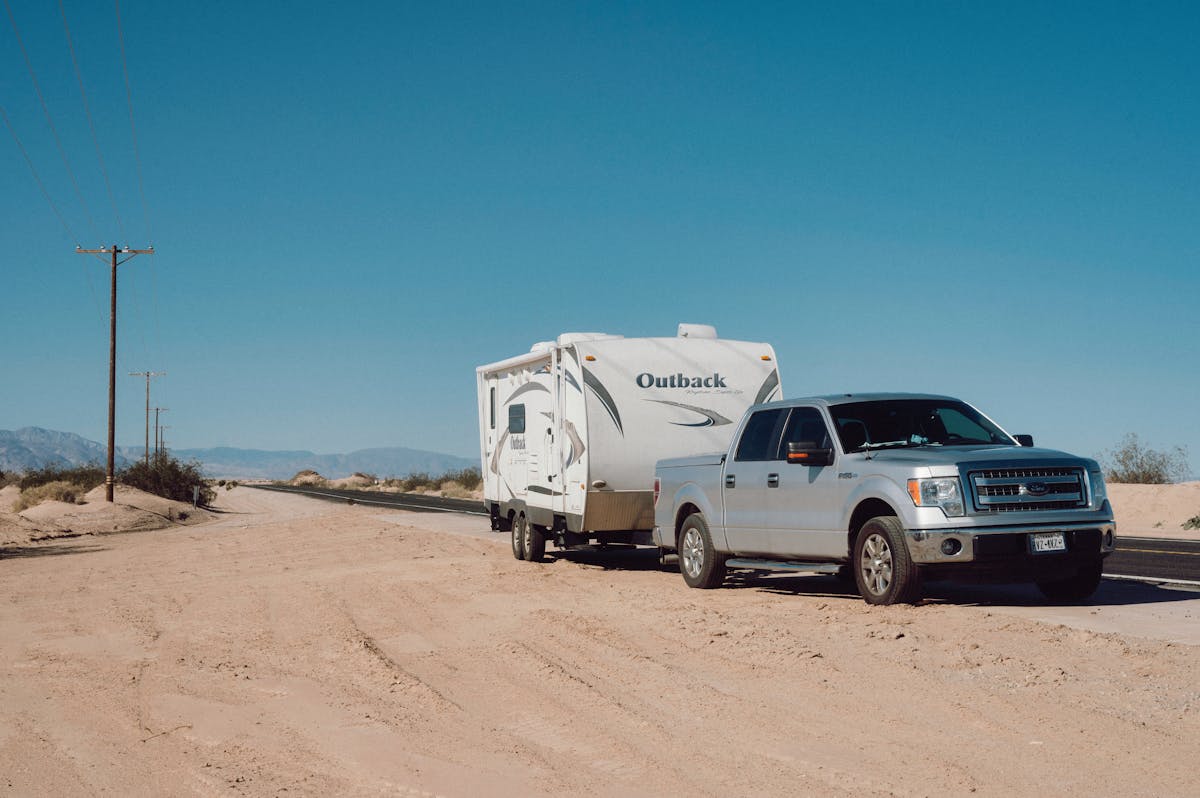
This is the situation thousands of half-ton owners are unknowingly in. The truck still tows. The trailer still moves. Nothing snaps. But if you call your insurance company after a single-vehicle accident and the responding officer notes that you were 340 lbs over GVWR — well, "Good Luck Out There" doesn't begin to cover that conversation.
Fifth wheels: the rear axle problem
If half-ton + travel trailer is the most common "almost overloaded" combo, half-ton + fifth wheel is the one that pegs us awake at night.
Pin weight on a fifth wheel is typically 18–25% of loaded trailer weight. On a 12,000-lb fifth wheel — pretty typical for a family unit with two slides — that's 2,160 to 3,000 lbs of pin weight sitting directly above the rear axle of your truck. Most half-tons have a rear axle weight rating around 4,000–4,400 lbs. Subtract the truck's own rear-end weight (~2,800–3,200 lbs depending on configuration), and you might have 1,000–1,600 lbs of headroom on the rear axle before you exceed RAWR.
Add 2,500 lbs of pin weight to that and you're 900 to 1,500 lbs over rear axle rating. The fifth-wheel hitch hardware itself adds another 150–200 lbs to the same axle. This is the configuration that produces the YouTube videos of bowed truck frames and rear leaf springs squashed flat.
This is why the conventional wisdom — "you need at least a three-quarter-ton to pull a fifth wheel" — exists. It's not a brand-loyalty thing. It's an axle math thing. There are half-tons spec'd to handle lighter fifth wheels, but you have to do the rear-axle math, not just the tow-rating math.
The honest version
If you're shopping for a fifth wheel and the dealer says "your half-ton will handle this just fine," ask them to walk through the rear axle weight math with you. Most can't, because the answer is usually "no, not really." That doesn't mean you can't tow it — it means you should know what you're choosing before you sign.
The GCWR ceiling and why nobody hits it first
GCWR (gross combined weight rating) is the ceiling for the whole truck-and-trailer system. It's a real limit, and exceeding it puts strain on your engine, transmission, and brakes that the manufacturer hasn't validated.
But in practice, very few RV owners hit GCWR before they hit payload or tow rating. The reason is that GCWR numbers tend to be generous, and the truck's curb weight + a trailer's loaded weight rarely reach the combined limit even when other ratings are blown. So GCWR is the number that catches "I'm pulling a 16,000-lb fifth wheel with a half-ton" cases, but the more common overload pattern shows up in payload first.
Still — write down your GCWR. If you ever roll the loaded combo across a CAT scale (which you absolutely should, at least once), the sum of front axle + rear axle + trailer axles should be under GCWR. If it's not, the truck is fundamentally too small for the trailer regardless of what the tow rating sticker said.
How to actually weigh your rig
Spec sheets are a starting point. Real numbers come from a scale. Every commercial truck stop with CAT scales will weigh your rig for around $12-15. Pull on, put the front axle on one pad, the rear axle on the next pad, the trailer axles on the third pad. They print you a ticket.
What you want to see:
- Front axle weight < front axle weight rating (FAWR, on door sticker)
- Rear axle weight < rear axle weight rating (RAWR, on door sticker)
- Front + rear < truck GVWR
- Trailer axles < trailer GVWR (from trailer door sticker, separate)
- Sum of all axles < GCWR
If anything is over, the cheapest fix is usually re-loading: move heavy items from the bed of the truck into the front compartment of the trailer (or vice versa, depending on what's over). The more expensive fix is more truck. The most expensive fix is what comes after a wreck.

Tongue weight in practice (and the dry-weight trap)
Spec sheets list dry tongue weight — the tongue weight of the trailer empty of water, propane, food, gear, and the dealer-installed add-ons. By the time you've filled the freshwater tank for a weekend, loaded the front pass-through with chairs and tools, and put two full propane tanks on the A-frame, your tongue weight can be 25–40% heavier than the dry spec.
This is why two trailers with similar dry weights can behave completely differently on the road. A trailer with the freshwater tank ahead of the axles will sit heavy on the tongue. A trailer with the freshwater tank behind the axles will sit light — and a too-light tongue weight (under ~10% of trailer weight) is its own problem, because it's the dominant cause of trailer sway.
For travel trailers, target a tongue weight of 12–15% of loaded trailer weight. For fifth wheels, target 18–25% pin weight. Either way, the only way to know is to weigh it loaded the way you actually travel — not the way the brochure imagined you would.
Choosing the truck (or choosing the trailer)
Here's the conversation we wish we'd had with someone in 2017 instead of the conversation we had with the dealer:
Start with the family, not the rig. Add up the realistic loaded weight of you, your spouse, your kids, your dog, your typical bed cargo, your hitch hardware. Whatever that number is, subtract it from your truck's payload. What's left is the maximum tongue or pin weight your truck can support.
Work backwards to trailer size. Divide that remaining payload by 0.13 (for travel trailers) or 0.22 (for fifth wheels) to get the maximum loaded trailer weight that respects your payload. That's your ceiling. Trailers above that ceiling are either out of reach, or they require a bigger truck, full stop.
Trust the door sticker over the brochure. Two trucks of the same nominal model can have payload numbers that differ by 400 lbs depending on options, axle ratio, and trim. The door sticker is yours specifically. The brochure is for "your model in general."
If the math is borderline, choose the trailer that fits the truck rather than the truck that pretends to fit the trailer. Going up a trailer class is cheaper, easier, and more reversible than going up a truck class. And as your family changes, your trailer can change with it — without you needing to also change your tow vehicle every three years.
Where this connects to everything else
The reason we hammer on this so much is that towing math sits upstream of almost every other safety conversation in RVing. Weight distribution hitches compensate for some of the tongue weight effects on a travel trailer, but they don't increase your payload capacity. Tire pressure monitoring tells you when a tire fails, but overloaded axles cause tire failures in the first place. RV tire safety goes hand in hand with not exceeding axle ratings. And before you sign on any RV at all, the questions you ask before signing should absolutely include whether the rig fits the truck.
This is also why we charge for pre-purchase consulting. Half the calls we take are buyers whose dealer already told them "your truck can handle it" and who are about to learn — slowly, expensively, or all at once — that the math doesn't agree. Twenty minutes on a phone call with someone who's done this math a hundred times is the cheapest insurance in the RV world.
What to do this week
If you already own a tow vehicle and a trailer:
- Walk to your truck and read the door-jamb sticker. Write down GVWR, payload, GAWR (front and rear), and tow rating.
- Pull your trailer's spec sheet or the sticker on its A-frame. Note dry weight, GVWR, and dry tongue weight (or pin weight).
- Estimate your loaded payload using the categories above.
- Find a CAT scale on your next trip. Spend $12 and get the truth.
If you're shopping:
- Get the door sticker payload number of the specific truck on the lot (not the model in general). Take a photo.
- Calculate the maximum trailer weight that respects your payload using the math above.
- Bring that number to the trailer lot. Anything over it is a no.
- If you fall in love with something over the line, the answer is a different truck — not a hand-wave from the dealer.
Towing isn't scary. Towing badly is scary. The difference between the two is mostly just five minutes of arithmetic that the industry, for reasons that probably have something to do with selling more trailers, has decided not to volunteer.
You don't need an engineering degree to do this. You need a sticker, a calculator, and a willingness to do the math before you fall in love with a rig. That's it.
Good Luck Out There!