
TL;DR
RV tires age out before they wear out. The DOT date code on the sidewall tells you exactly how old each tire is, and most RV tire experts treat 5–7 years as the working service life regardless of tread depth. Sidewall cracking, weight overload, and underinflation are the three failure paths. None of them care that the tire "looks fine."
The most expensive sound we've heard in five years of RVing is the bang a tire makes when it lets go on a freeway. It happened to us once, on the Coachmen Pursuit, in 100-degree heat in Arizona. The tread peeled off a rear inner dual and took with it a fender, a section of belly skin, the wiring for a rear tail light, and (we found out later) a chunk of the gray tank. The tire that failed had a DOT date code that put it at almost six years old. The tread looked fine. The pressure was correct. The rig wasn't overweight. None of that mattered.
RV tires are different from passenger car tires in a way that catches almost every new owner off guard: they age out long before they wear out. A passenger car tire on a daily-driven sedan typically wears its tread down to replacement depth in 50,000–70,000 miles, which is three to five years of normal use. By the time the tread is gone, the rubber compound is also degraded — the two timelines line up. RVs work differently. The average RV puts on 5,000 miles a year. At that rate, the tread will last 15+ years. The rubber will not. This mismatch is, in our view, one of the most under-talked-about RV safety issues, and it's the one we lean on hardest in pre-purchase consultations.
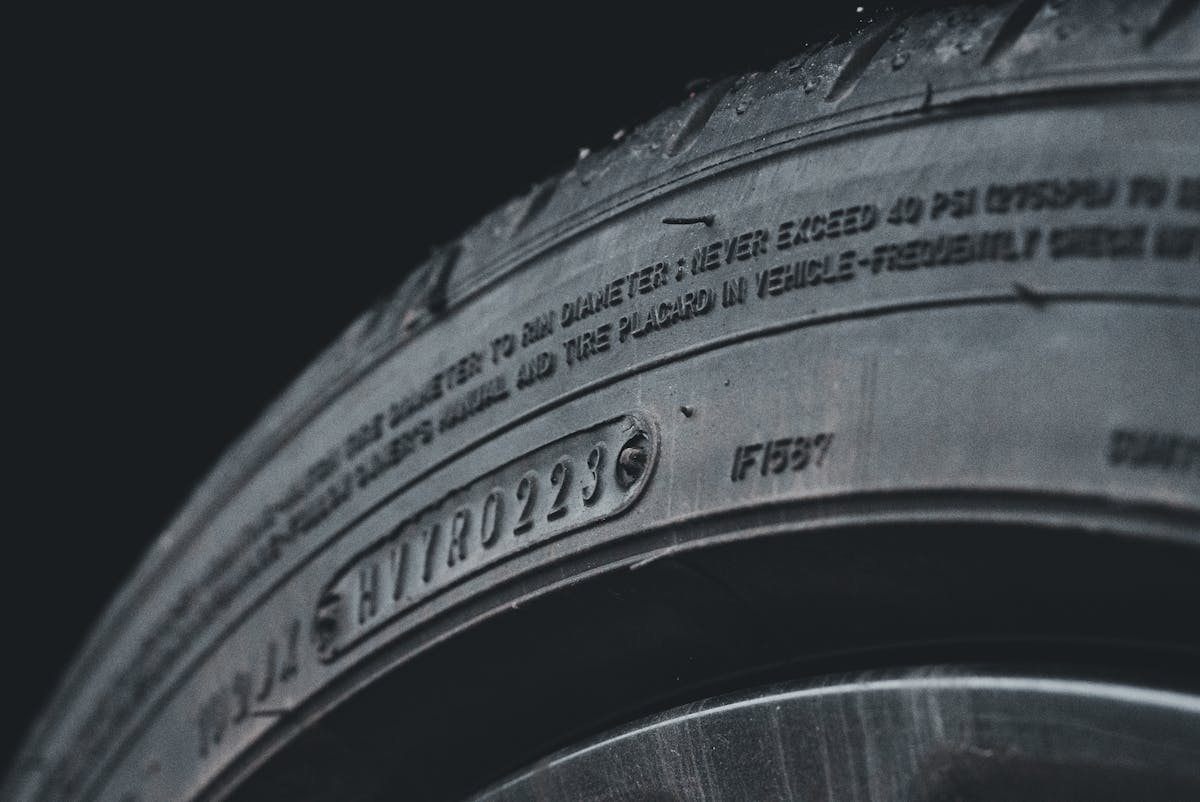
How to read a DOT date code
Every tire sold in the U.S. has a Department of Transportation identification number molded into the sidewall. The relevant part for age is the last four digits — week of manufacture, then year. For example:
- "2422" = the 24th week of 2022. So manufactured in mid-June 2022.
- "0519" = the 5th week of 2019. Late January 2019.
- "5217" = the 52nd week of 2017. December 2017.
One quirk worth knowing: the DOT code is only required on one sidewall, by federal regulation. The outboard side often shows it; the inboard side often doesn't, or shows an abbreviated version. If you can't read the code from one side, you may have to crawl under the rig and look at the inboard side. Frustrating, but that's how the regulation works.
Tires manufactured before 2000 used a three-digit code (no decade indicator). If you find a three-digit code on a tire in 2026, it doesn't matter how old it is — it's far too old. Replace it before you drive the rig anywhere.
Check the date on every tire. Including the spare. Especially the spare — spares routinely sit unused for the entire service life of the rig and many owners replace the main tires on schedule while leaving a fifteen-year-old spare on the rear ladder.
The 5–7 year rule
RV tire manufacturers and most RV tire authorities converge on a rough consensus: an RV tire should be replaced at 5–7 years of age regardless of tread depth, and inspected critically after year 3. Why this range and not, say, 10 years?
Tires are made of rubber compounds that include oils, plasticizers, and antiozonants designed to keep the rubber flexible and resistant to UV and ozone degradation. Over time, those additives off-gas, migrate, or oxidize. The rubber gets harder, less elastic, and starts to crack — first microscopically, then visibly. The cracks usually appear first on the sidewall (which flexes the most) and the tread shoulder. Once cracking starts, the structural integrity of the tire is compromised even if the tread is deep.
The 5-year mark is when this degradation becomes noticeable for tires used in normal conditions. The 7-year mark is where most experts say you're rolling dice. Outside of 7 years, the question isn't if a tire fails, it's when.
Heat accelerates the process. RVs parked in Phoenix or Las Vegas in summer age their tires faster than RVs parked in Maine. UV exposure accelerates it. Underinflation accelerates it. Time on the road in hot conditions with heavy loads accelerates it dramatically. Some owners we know in extreme climates replace at 4 years.
The honest version
The 5–7 year rule isn't a manufacturer rule designed to sell more tires. It's the consensus of the technicians who unbolt failed tires for a living. Believe them.
What sidewall cracking looks like
You don't need a tire gauge to spot a tire that's aging out. You need a flashlight and your eyes. Walk every tire and look for:
- Surface checking. Tiny hairline cracks in the sidewall rubber. Looks like crazed pottery. Concerning if it's deep enough to catch a fingernail; advisory at any depth.
- Cracks at the base of the sidewall. Where the sidewall meets the tread. This area flexes more than anywhere else and cracks here are an early failure indicator.
- Cracks between tread blocks. Different from tread wear — these are in the rubber itself, running deeper than the tread groove.
- Visible cord. Brown or yellow strands showing through worn or cracked rubber. The tire is structurally exposed. Out of service immediately.
- Bulges or lumps. A localized swelling in the sidewall means an internal belt or ply has separated. The tire is going to fail. Could be today, could be in 1,000 miles.
- Asymmetric wear patterns. Cupping, feathering, one-shoulder wear. Doesn't mean the tire is dead, but it usually means alignment, inflation, or weight distribution is wrong.
None of these are subtle when you look for them. The reason most RV owners miss them is they never look. The tires sit, baking in sun, doing their thing, and the owner sees them only as black circles. Crouch down. Bring a light. Look at the sidewall properly. This is a one-minute task you should do once a month.
Weight, load rating, and the pressure math
RV tires fail from age. They also fail from being asked to do more work than they're rated for. The math here is more important than most owners realize. Every RV tire has a load rating (often labeled in pounds at maximum cold pressure), and every RV has a Gross Vehicle Weight Rating and per-axle weight limits. If your actual loaded weight on a tire exceeds its rating, you're operating outside the design envelope and failure risk climbs sharply.
The only way to know your real per-tire load is to weigh the rig fully loaded. The RV Safety & Education Foundation runs four-corner weighing events at major RV rallies; some larger truck stops have CAT scales that can weigh per axle. Once you know your real weights, look up the load rating chart for your specific tire (most manufacturers publish them) and confirm you have margin. We aim for 15-20% headroom on rated load; closer than that and we'd be uncomfortable on long hot drives.
Inflation pressure is the other half of the equation. The pressure printed on the sidewall is the maximum cold pressure for the tire — not necessarily the right pressure for your specific load. You want the cold pressure that corresponds to your actual loaded weight on each tire, per the manufacturer's chart. Running max sidewall on a lightly loaded tire gives a stiff ride and uneven wear; running too low at full load builds heat and kills tires. Air pressure is the variable you control. Use it.
Cold means cold. First thing in the morning, before driving, before sun on one side. Pressure rises 1-2 psi for every 10°F of temperature increase, and rises further when the tire flexes during a drive. Check pressures cold and adjust to spec; don't bleed off "high" hot pressures because the tire heated up.
TPMS — worth it, in our opinion
A Tire Pressure Monitoring System on an RV is one of the highest-value safety upgrades available. We have a full post on TPMS for RVs with the longer argument; here's the short version. A TPMS gives you real-time tire pressure and temperature for every wheel position, including duals you can't see and trailer tires you can't easily access. When a tire starts to lose pressure slowly, you find out before the failure — often before the tire is even damaged.
Both of the catastrophic tire events we've personally experienced would have been preventable with a TPMS we didn't yet have. We have one now. We will never tow without one again. The cost is somewhere between $200 and $600 depending on the system. It is, in our experience, the single best safety dollar in RVing.
ST vs LT vs commercial tires
Most travel trailers and fifth wheels ride on "ST" (Special Trailer) tires. These are purpose-built for trailer service, with reinforced sidewalls and a load rating optimized for the static, no-cornering load profile of a trailer wheel. Motorhomes typically run "LT" (Light Truck) tires or, on larger Class A coaches, true commercial truck tires.
The categories aren't interchangeable. An ST tire is not designed to be steered. An LT tire is not built for the sidewall load profile of a trailer. Putting passenger car ("P") tires on either an RV or a trailer is a bad idea regardless of how the math looks — the construction is wrong for the application.
If you're upgrading tires, stay in your category. Within the category, the major brands have meaningful quality differences, and some lesser-known brands have meaningfully worse failure rates. The RV-tire community on forums like iRV2 has long-running threads on which brands have held up well and which haven't. Treat their experience as data, not gospel, but the patterns are real.
Speed ratings and the 65 mph reality
Most ST tires are speed-rated to 65 mph at maximum load. Some newer ST tires are rated to 75 or 81 mph. The rating is real. Driving an ST tire at 75 mph when it's rated for 65 generates more heat than the design accommodates, and heat is the enemy of tire life.
If you tow a trailer, check your tires' speed rating. If you're rated to 65, drive 60. If you want to drive 70, upgrade to a properly speed-rated tire. The temptation to "just go a little faster" is real, especially on long days, but the trade-off in tire life and failure risk is not worth it.
Motorhomes are typically on LT or commercial tires with higher speed ratings, so this is less of a constraint. Even so, RV-recommended cruising speeds top out around 65 for safety reasons that go beyond tires (handling, stopping distance, fuel economy).
Spare tires: the forgotten item
If you have a spare, when did you last look at it? Same age rules apply. A spare bolted to the back ladder for ten years is not a spare; it's a decorative object that will fail catastrophically the first time you put it under load.
- Check the spare's DOT date code with everything else.
- Rotate it into service if you have a chance, or replace it on the same cycle as the rest.
- If the spare is under-rated for your loaded weight (common on RVs that came from the factory with a downgraded spare), it's a get-you-to-a-tire-shop tire, not a finish-your-trip tire.
- UV-protect it if it lives outside. A simple cover helps.
UV protection and storage
The biggest controllable factor in how fast your tires age is exposure to sunlight and heat. A few low-effort interventions:
- Tire covers in storage. Cheap. Effective. The cumulative UV hours over a winter of storage in a sunny parking spot will measurably age the rubber.
- Park on something other than asphalt or concrete. Both retain heat and can promote bottom-side cracking on stored tires. Boards, mats, or grass help.
- Don't park on petroleum-contaminated ground. Driveways with old motor-oil stains, fueling areas — petroleum is the natural enemy of tire rubber.
- Move the rig occasionally even in long storage. A few feet, every couple months. Keeps the same patch of tire from sitting under load against the same patch of ground.
- Skip the tire shine products with petroleum solvents. Dressings that promise glossy black tires often accelerate cracking. Water-based products are okay.
None of this individually changes much. Together they push you toward the long end of the service-life window rather than the short end.
What FMCSA, DOT, and NHTSA actually say
For commercial vehicles, the Federal Motor Carrier Safety Administration regulates tire condition and inflation. Most RV owners aren't operating commercially, but the FMCSA standards are a good reference for what "minimum acceptable" looks like for tires under load.
The National Highway Traffic Safety Administration tracks tire recalls and investigations. Worth checking your tire model against the recall database, especially if you're buying used or recently took delivery of a new rig with factory-supplied tires. NHTSA also publishes guidance on tire aging that backs up the 5–7 year service life consensus.
The NHTSA tire safety page includes consumer-focused materials on date codes and inspection. We've linked it from our annual maintenance checklist and we'll keep linking it; the information is good and it's primary-source.
The "looks fine" failure
The single most frustrating tire failure we've witnessed wasn't ours. A family we'd met at a Texas state park was on day three of a planned three-week trip when their right-side fifth wheel tire delaminated at speed. The blowout damaged the underside of the rig, ripped out a section of bottom skin, and took out a propane line. Nobody was hurt, but the trip ended that afternoon. They were back home by Friday. The tire that failed had visibly cracked sidewalls. The tread was barely worn. The DOT date code put it at 8 years.
The owner told us he'd bought the rig used two years earlier and assumed the previous owner kept up with tires. He didn't check the date codes. The dealer didn't mention them. The pre-purchase inspection didn't include them. Eight years, fifteen hundred dollars of damage, one ruined vacation. Three minutes of date-code reading at the inspection stage would have caught it.
That story plays out somewhere in the RV community every weekend. If you take one habit from this whole post, take the habit of looking at every DOT date code on a rig before you trust it. We do this on every pre-purchase consultation and we've turned up shocking tires more often than we'd like.
The honest version
The depressing reality is that the RV industry routinely ships new rigs with tires that have been sitting on the build line, then in transit, then on the dealer lot, for so long that the tires are already a year or two into their service life when the buyer takes delivery. We've seen brand-new rigs with 2-year-old tires. Check date codes when you take delivery, not just years later.
What this means for you
Find every DOT date code on your rig today. Write the dates in your maintenance log. Set a calendar reminder for the year you'll replace each tire. Buy a TPMS if you don't have one. Check pressures cold, monthly. Weigh the rig once and confirm your tires have load-rating headroom. Look at sidewalls under a flashlight, not from ten feet away. Don't trust the dealer or the previous owner — verify it yourself. And don't let "the tread is fine" talk you into one more season on aging rubber.
Tire failures on an RV are loud, expensive, and dangerous. They are also almost entirely preventable. The dollars you spend on time-based tire replacement are some of the cheapest dollars in RV ownership.
Good Luck Out There!