
TL;DR
Most RV travel-day disasters are preventable with a written checklist, realistic distance planning, and a clear division of labor between driver and co-driver. The 3-3-3 rule (300 miles, by 3 PM, every 3 days) is a solid starting point. Arrive before dark, always. The travel day is the most dangerous day of the week and deserves the most boring routine.
If we had to identify the single highest-stress day of a typical RV week, it'd be travel day. Not for the obvious reason — driving the rig is the easy part once you've done it a few times — but because travel day is when small mistakes get expensive. Forget to retract a slide and you can damage the rig. Forget to chock the wheels before unhitching and you can damage your spouse. Forget to check tire pressure and you can damage the truck and the trailer. Forget to plan the route around low-clearance bridges and you can damage everyone.
This post is the routine that worked for us after enough travel days to make it reliable. We aren't going to pretend our system is the only right one. We are going to walk you through what we do, in the order we do it, and why each piece is on the list.
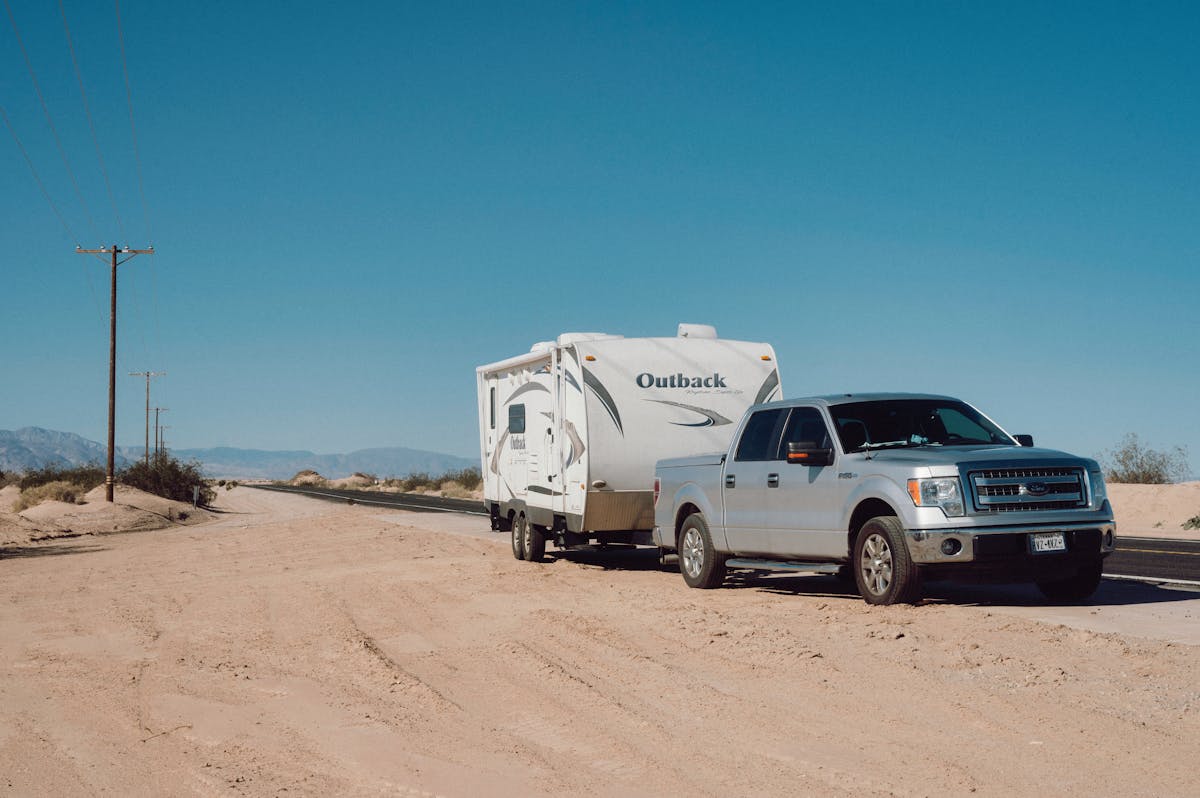
The 3-3-3 rule (and why it actually works)
The 3-3-3 rule is full-time RV community shorthand for: drive no more than 300 miles a day, arrive by 3 PM, and stay at least 3 nights at each stop. Some people use 2-2-2. Some use 4-4-4. The exact numbers are not the point. The point is the structure.
300 miles a day, max. Most days much less. 300 is a long day with an RV behind you. With a fifth wheel or larger trailer, you're driving slower than car traffic, you're stopping more often, and 300 miles in seven or eight hours is realistic but tiring. Six hours of actual driving time, plus an hour of stops, plus an hour of unexpected stuff, and that's a full workday with no margin. The single biggest mistake new full-timers make is "I can do 500 miles in a day, no problem." I have done 500 miles in a day. I did not enjoy it. The rig did not enjoy it. The next morning was a sit-in-the-rig-and-recover day. There is no badge for high miles per day in RV life.
Arrive by 3 PM. This is the most important number on the list. Arriving at 3 PM means you have time to find the site, level the rig, do hookups, walk the dog, and have everything done by 5 — with daylight to spare. Arriving at 7 PM means you're setting up in dim light, missing things, more likely to make a mistake, and starting your stay tired. Arriving after dark is a much higher-risk situation: you can't see the site, you don't know what's overhead, you're more likely to clip something, and your new neighbors are trying to sleep when you fire up the leveling jacks.
3 nights minimum at each stop. The "two nights" pattern is the burnout pattern. You set up, you sleep one night, you barely have time to breathe, you pack up, you drive. The math of breaking camp and setting up is the same whether you stay two nights or two weeks; the longer you stay, the more value you get from the setup work. Three nights is the floor. Five to seven is the sweet spot for most of our trips. Two weeks is where it starts feeling like home again.
The rule isn't a religion. We've broken every part of it. We've done 400-mile days when we had to. We've done one-night stops in transit. We've arrived after dark twice in seven years, both times with significant regret. The rule is the default; deviations should be the exception.
The pre-departure checklist (the one we actually use)
Every full-time RVer needs a pre-departure checklist. The ones who don't have one are the ones that, sooner or later, drive away with a slide partially extended or an awning that didn't fully retract. I've seen both. I've nearly done both. This is why the checklist exists.
Our checklist, in the rough order we run it. Yours will be different in details; the structure is what matters.
The night before:
- Plan the route. Look up the destination address. Check for low bridges, weight-restricted roads, mountain passes, or known trouble spots. iRV2 forums and similar resources have local knowledge for problem routes.
- Check weather along the route. High wind days are when we don't travel if we have any choice. 25+ mph crosswinds in a fifth wheel is a different kind of driving day than 5 mph.
- Confirm the reservation at the destination. Make sure you have the address, the site number if assigned, the after-hours check-in procedure if you arrive late.
- Pack up anything outside that doesn't need to be out in the morning. Camp chairs, cooking gear, bikes, the rug under the awning. Doing this the night before makes the morning routine much shorter.
- Fill the fresh-water tank if needed; empty black and gray tanks at the dump station if convenient.
- Verify you have fuel in the truck. Don't start travel day looking for a gas station immediately.
Morning of, before hitching:
- Walk the rig perimeter. Look at the roof for anything that shouldn't be there. Look at the slides — both that they'll retract cleanly and that nothing is wedged against them.
- Inside: secure everything that could fall. Cabinet doors latched. Bathroom door secured. Bedroom door secured. Refrigerator door latched (the travel latch, not just the everyday latch). Any loose object on a counter — coffee maker, knife block, toaster — goes in the sink or in a secured cabinet.
- Bring in any loose stuff. Books, gear, the iPad. Everything that doesn't have a home gets one before the rig moves.
- Retract the awning fully. Verify the lock is engaged.
- Disconnect water hose. Drain it. Stow it.
- Disconnect sewer hose. Drain it. Stow it. Both caps on.
- Disconnect shore power. Coil the cord. Stow it.
- Empty and disconnect any propane appliances that need it for travel — check your specific rig's rules. Some rigs allow propane fridge to run during travel; many do not (and gas stations explicitly prohibit it at the pumps).
- Stow leveling blocks, wheel chocks (after hitching), and any outside items.
- Retract the slides. Watch them come in. Verify they're flush. Verify the seals are clean. Verify nothing is in the way inside (chairs, bags, anything).
- Retract the leveling jacks. All of them. Verify they're up.
The hitch-up routine:
- Back the truck to the trailer. Use a spotter — one of you drives, the other guides. We use hand signals we agreed on years ago. If you don't have hand signals, use radios or phones on speaker.
- Connect the hitch. For a fifth wheel: lower the pin onto the hitch, verify it latches, install the safety pin. For a travel trailer: lower the coupler onto the ball, verify it latches, install safety chains and breakaway cable.
- Plug in the trailer's electrical connector. Check the running lights, brake lights, turn signals — both sides. Co-driver stands behind, calls out what they see.
- Verify trailer brakes are working — driver gently presses the trailer brake controller while watching the trailer.
- Verify the breakaway cable is attached and the breakaway battery is charged.
- Raise the trailer's landing gear all the way up. Verify it's all the way up.
- Remove the wheel chocks. Last step before the wheels can roll.
Final walk-around, before driving:
- Walk the entire rig perimeter one more time. Look at the slides (still in?), the awning (still locked?), the landing gear (all the way up?), the steps (retracted?), the doors (closed and latched?), the propane (off or as appropriate?).
- Look up. Are there overhead branches you'll hit on the way out? Power lines? Awnings of neighboring rigs?
- Look under. Is there a pad or block you forgot to pull?
- Check tire pressure on the truck and the trailer if you haven't already. Cold pressure, before the day's heat builds.
- Pull away slowly. The first 50 feet of travel day is when you find any last problem.
The honest version
I keep a paper version of this checklist in a binder in the truck. Not because I don't remember the steps. Because on the morning of a travel day, after two cups of coffee, the cognitive load is high enough that "I'll remember" is a lie. I check the list every time. I have caught a partially-extended slide. I have caught a forgotten chock. I have caught a sewer hose still attached. The checklist works because the moment of the morning rush is the worst possible moment to rely on memory.
Division of labor: driver and co-driver
If you're traveling with another adult, the work splits roughly cleanly. Specializing is easier than negotiating every time.
Driver tasks: route planning, fuel stops, the actual driving, hitch connection, mirror checks, weather monitoring, the truck-side electrical and brake checks.
Co-driver tasks: interior buttoning-up of the rig, navigation and route updates, lookout for signs and exits, lookout for hazards the driver might not see, dispensing snacks and water, managing any pet stops.
Shared tasks: the walkaround. The pre-departure checklist. The "should we keep going or pull off because of weather" call. The "we're tired, should we shorten today" call.
The single biggest sanity-saver we've found is to not have decision-making conversations during the actual drive. The driver is driving. The co-driver is doing 12 other things. Big decisions — where we're stopping, whether we're going to the campground or pushing on — get made before we leave the morning's stop, or at a rest area, not in motion. Anything in motion is a quick yes/no.
What you put in the truck cab (not in the rig)
Whatever you need during the drive lives in the cab. Whatever you don't need lives in the rig. Treating the cab as a 6-hour mobile living room makes the day much better.
Standard cab inventory:
- Water bottles for every passenger.
- Snacks. Real snacks. Not a granola bar and then nothing for six hours.
- Sunglasses. Two pairs, in case one gets lost.
- Sunscreen if it's a sunny day and the side of your face will be exposed for 6 hours.
- A small first-aid kit for the routine stuff (cuts, headaches, the things you don't think about until you need one).
- Phone chargers, plural. The phone is the navigation, the music, and the communication tool. Don't run it dry.
- Entertainment — books, downloaded shows on a tablet, headphones. Pre-loaded. Don't rely on cellular to stream during the drive; coverage drops randomly.
- The dog's water bowl and a leash within reach.
- A small trash bag. The cab fills up faster than you think.
- Cash and a couple of cards, easy to reach. Some toll roads are cash-only in places. Some weigh stations want a card. Don't dig through wallets at the toll booth.
- The paper checklist binder, which doubles as the documents binder if anything official happens.
The drive itself
RV driving is mostly slower-truck driving. A few things specific to towing.
Speed. Most RV tire ratings limit you to 65 mph or so. Many trailer tires are rated lower. Don't exceed the rating; tire failures at speed are the biggest cause of RV roadside disasters. We cruise at 60-62 mph in most conditions. We've found we get there at the same approximate time as the people doing 75, because they have to stop for gas more often.
Following distance. Bigger than you're used to. The rig stops slower than a car. The car ahead of you can stop fast. The math is unforgiving.
Mirror discipline. Check both mirrors every few seconds. Always. Cars come up the right side. Trucks come up the left. The blind spot of a tow rig is large.
Lane changes. Signal early, signal long, change slowly. You are larger than the people around you and they will react to your signal — but only if you give them time.
Wind. Crosswinds push the rig around. Tucker (truck plus camper) is even more vulnerable. In gusty conditions, both hands on the wheel, speed down 5-10 mph, more space around you.
Mountain passes. Downshift on the descent. Use the engine to brake, not the brakes. Trailer brakes assist but they aren't the primary stopping mechanism. We've smelled brakes on the side of an interstate. We've never wanted to be the rig those brakes belonged to.
Construction zones. The classic RV-trailer disaster. Lanes narrow, walls move in, mirrors clip things. Slow down further. If a lane is too narrow, take the wider one.
Rest stops. Every 2-3 hours minimum. Walk around the rig. Hand-check the wheels for heat (a hot wheel is a sign of a stuck brake or a bearing problem). Check the tires for damage. Check that the rig is still hitched. (Yes. Every stop. The whole point of a checklist culture is to never assume.) Walk the dog. Stretch.
If road conditions get truly bad — heavy snow, blizzard, severe thunderstorms — pull off. Find a truck stop. Wait it out. We have spent six hours in a Cracker Barrel parking lot waiting for a snow squall to pass. We have not regretted it once.
Arrival: the setup routine
You arrive. You found the site. The site is more or less what you thought it would be. Now you set up. The same logic as departure: a routine, every time, in order.
- Pull in slowly. Look up for branches. Look around for hookups. Pick the spot that puts the door on the side you want and the slides on the side you want and the hookups within hose reach.
- Spot the rig. Use the spotter (co-driver). Hand signals. Slow.
- Level rough. Pull forward or back until the site is as level as the surface allows. Use leveling blocks under the low-side wheels if needed.
- Chock the wheels. Both sides, both wheels if possible. Before doing anything else with the trailer.
- Unhitch. Reverse of the hitching routine. Lower the landing gear. Disconnect electrical. Disconnect coupler / pin box. Drive the truck out from under.
- Final level with auto-leveling or manual jacks. Front-to-back, side-to-side. The fridge needs near-level; the rest of life appreciates near-level.
- Slides out. Watch them come out. Verify the seals are clean and the path is clear.
- Connect water. Use a water pressure regulator. Hose to the spigot, hose to the rig, valve on.
- Connect sewer. Hose to the rig outlet, hose to the dump pipe, support along the way if needed. Both caps off.
- Connect electrical. Surge protector / EMS first, then cable, then plug into the pedestal. Verify voltage and polarity on the EMS readout.
- Extend the awning if weather allows. Some campgrounds we don't bother — wind risk, short stay. Most we do.
- Walk the rig perimeter. One slow walk. Anything wrong?
- Walk the dog. Even five minutes. Reset for everyone.
- Sit on the couch for ten minutes. The decompression matters. Do not start cooking, do not start work, do not start anything else. Sit. Drink water. Breathe.
Half an hour to forty-five minutes, start to finish, if everything goes well. An hour if something is funky about the site. We have done it in 25 minutes when we were sharp; we've done it in 90 minutes when we were exhausted. Both are okay. The routine is what matters.
The "arrive before dark" rule
Of all the rules in this post, this is the one we'd break last. Arriving in daylight is the difference between a small problem (the site is muddier than you thought) being a small problem and being a real problem. Arriving after dark, you can't see the overhead branches, you can't see the soft spot in the gravel, you can't see the neighbor's awning you almost clipped, and you can't see the hookups well enough to verify them.
If something goes wrong during the day and you're going to arrive after dark, the right call is almost always to stop somewhere else for the night and finish tomorrow. Truck stops, rest areas, Harvest Hosts, Walmart parking lots (where allowed) — there's almost always a "rest until tomorrow" option. Yes, it inconveniences your destination plans. The alternative — setting up in the dark, tired, with a higher risk of damaging the rig or yourself — is worse.
We've enforced this for years. The few times we've had to deviate, we've regretted it. It is the cheapest rule to follow and the most expensive rule to break.
What we'd tell a new full-timer about travel days
Write the checklist. Run it every time. Drive less than you think you need to. Stop more than you think you need to. Eat better than gas-station food when you can. Don't try to make up for being behind by driving longer. Pull off when you're tired. Pull off when the weather is bad. Pull off when something feels off.
And give yourself grace on the day you mess one of these up. I have, on a memorable occasion, made it forty miles down the road before realizing the slide hadn't fully retracted. Nothing bad happened — the slide was 95% in, the corner clearance was fine, no damage. But I went silent for the rest of the drive. I added "physically verify each slide is flush" to the checklist in red ink. The lesson cost me about an hour of stomach-clench and a permanent improvement to the system. That is how travel-day routines get built. Mistake by mistake, line by line, until the checklist runs the system.
Travel days are the most boring days when they go right. That is the goal. Boring is good. Boring means everyone is alive, the rig is fine, and you're sitting on the couch at the new site at 4 PM with a beer and a dog at your feet, looking out at a new view. Good Luck Out There!