
TL;DR
Boondocking is dispersed camping on public lands with no hookups — and it's the best free real estate in the country, if you know how to handle water, power, holding tanks, and basic safety. Start small, build redundancy, and respect Leave No Trace. The first few times feel intimidating; by the fifth, it'll feel normal.
Some of the best nights we've had in seven years of full-time RV life have been on public land with no neighbors, no pedestal, no Wi-Fi, and no one nearby for half a mile. We have watched mountain weather roll across a valley from the comfort of our rig, parked alone in a high desert with no one around for an hour's drive. That kind of night is one reason RVing exists. It is also, paradoxically, the kind of night most new RVers never have, because boondocking feels intimidating from the outside.
This post is the first-timer's version of how to do it without overpromising. We will not tell you boondocking is "easy" — it isn't easy, exactly, but it's learnable in a weekend. We will tell you what we wish someone had told us before we tried our first night without hookups, and what we still see new boondockers blow on a regular basis.
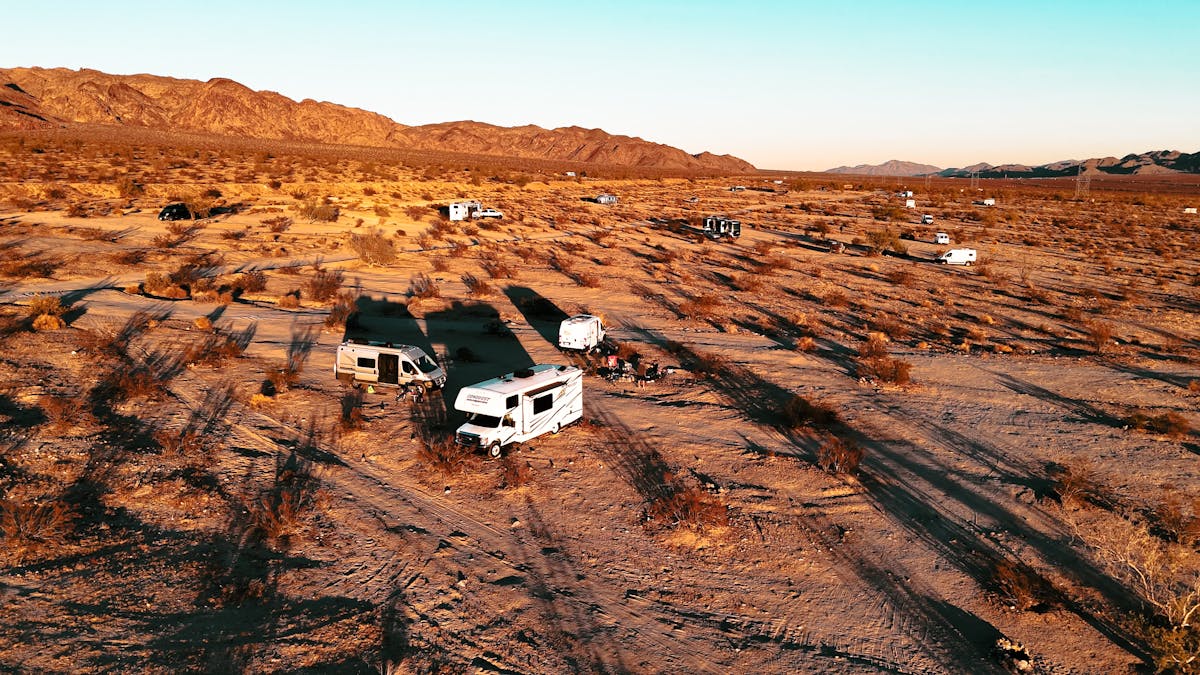
What boondocking actually is (and isn't)
"Boondocking" is shorthand in the RV community for camping without hookups — no shore power, no water spigot, no sewer. The word gets used a few different ways, and it's worth distinguishing.
- Dispersed boondocking on public land — the real thing. You drive into a BLM area or Forest Service area, you pick a spot that isn't designated as a developed campground, you park, you camp. Often free, often limited to 14 days, varies by area.
- Primitive camping in a designated public-land campground — there's a spot, sometimes a fire ring, no hookups. Often $5-$15/night. Not technically dispersed, but close enough that the boondocking community usually counts it.
- Moochdocking — parking on a friend's driveway or property. Hookups optional. Not really boondocking in the off-grid sense, but uses some of the same skills.
- Walmart / Cracker Barrel / Cabela's parking lot overnight — emphatically not boondocking. It is "overnight parking" or "stealth camping" or "rest" depending on whom you ask. You're not off-grid; you're on asphalt. Allowed at some locations, banned at many others. It's a road-trip tool, not the lifestyle.
- Harvest Hosts / Boondockers Welcome — paid memberships that connect you with private hosts (wineries, farms, etc.) who let RVers stay overnight, usually with no hookups. Pleasant, social, structured. Adjacent to boondocking but with more rules. Sites: Harvest Hosts, Boondockers Welcome.
For this post we mostly mean the first two — actual off-grid camping on public land. The skills overlap.
Where to actually find boondocking spots
This is where most new boondockers get stuck. You can't just pull off a random road and assume you're allowed. Public land has rules; private land has fences; and "looks empty" doesn't mean "legal."
The real sources, in our order of frequency:
- BLM land. The Bureau of Land Management manages roughly 245 million acres in the US, mostly in the west, mostly with generous dispersed-camping rules. Typical limit: 14 days in any 28-day window. Sites are not marked; you find a clear, level pull-off on an existing road. The BLM website has interactive maps of designated dispersed-camping areas. Apps like Campendium, FreeRoam, and iOverlander layer user reviews on top.
- National Forest land. The US Forest Service manages another huge chunk of land, again mostly out west and in the upper midwest. Dispersed camping rules are similar to BLM but vary by district. Look up the specific forest's MVUM (Motor Vehicle Use Map) for what roads allow what camping.
- Some state lands, in some states. A handful of states allow dispersed camping on state trust lands or state forests. Rules vary wildly. Research before you assume.
- National park "primitive" or "backcountry" camping. National Park Service camping is mostly in designated campgrounds, not dispersed. Some parks have specific dispersed-camping areas in their backcountry but most require permits and are walk-in, not RV-suitable. National Park boondocking exists but is the exception.
- Apps you'll actually use: Campendium, iOverlander, FreeRoam, AllStays, The Dyrt. None are perfect. Cross-reference. User reviews are gold; recent date stamps are even more important than star ratings.
None of these are paid endorsements. They are the tools every boondocker we know uses. Pick one or two, learn them well, and don't trust a single source — public-land rules change, roads close, fire restrictions come and go.
Water: your hardest constraint
Most boondockers run out of water before they run out of power. The math is unforgiving once you start.
The average RV fresh-water tank holds 40 to 100 gallons. A family of four, with normal showering and cooking habits in a stick-and-brick, uses about 80 gallons of water per person per day. In an RV, with conservation, that drops dramatically — but it's not zero.
Realistic family-of-four daily water use, off grid, with conservation:
- Drinking and cooking: 2-3 gallons.
- Dishes: 1-2 gallons (using two-basin method, not a running tap).
- Hand washing, tooth brushing, etc.: 1-2 gallons.
- Quick "navy showers" (wet, soap with water off, rinse): 2-3 gallons per shower. Skip a day; do a wash-up with a washcloth instead.
- Toilet: half a gallon per flush is normal; you can use less.
That puts you somewhere between 10 and 20 gallons a day for a conservation-minded family. A 70-gallon fresh tank gives you 3-5 days, depending on discipline. After that you either pack up and go fill, or you bring water in.
The water-extension tools that actually matter:
- External water bladders or jerry cans. A few 6- or 7-gallon jugs in the truck bed let you make a water run without breaking camp. We use cube-style jugs because they stack flat when empty.
- A 12V water pump for transfer. Don't pour from a jug into a fill port — you'll spill half. A small transfer pump (~$30) makes the refill trivial.
- A water filter on the fill line. Public water sources vary in quality. Even if you trust them, a basic inline filter is cheap insurance.
- A separate drinking-water jug. We keep 2-3 gallons of drinking water in a dedicated jug. It's the easiest way to make sure that even if you're rationing tank water, the kids and adults always have clean drinking water.
The conservation habit that helps most: catch your "warm-up" water. When you turn on the shower or sink and wait for hot, that's a couple of gallons going down the drain. Catch it in a pitcher. Use it for dishes, for the dog, or for the toilet flush. Sounds fussy. Adds maybe an extra day of boondocking per fill.
Power: solar, battery, and the generator question
The other constraint. We have a whole post on RV solar sizing if you want the long version. Here's the boondocking-specific summary.
- Battery capacity is the foundation. Lithium has roughly twice the usable capacity of lead-acid for the same nameplate amp-hours. If you're boondocking seriously, lithium is the upgrade most boondockers do first. Our battery guide covers the trade-offs.
- Solar is the input. On a sunny day, a well-sized rooftop array refills your batteries during the day so you're back to "full" by sunset. On a cloudy day, solar produces a fraction of that. Plan for cloud.
- Generator is the backup. Quiet inverter generators (the orange one or similar) run a couple of hours in the morning, refill the battery, and let you do laundry-free off-grid for as long as you have fuel and patience. Most campgrounds and many boondocking areas have generator-quiet hours — usually 8 PM to 8 AM. Respect them. Boondocking neighbors hate generators more than they hate anything else.
- The propane / shore power dependency: some "boondocking" rigs cheat by running the propane fridge instead of the electric fridge. Propane is its own consumable; budget your tank. A 20-gallon propane tank in moderate weather lasts a week or more for fridge plus stove plus water heater plus minimal furnace.
The newbie mistake is to size power around "average use" and forget the bad-weather day. Three days of clouds. The kids are inside watching a movie. You're on a work call with the inverter running. Battery goes flat by dinner. Plan for the bad-weather day; you'll be fine on the good ones.
Holding tanks: the smelliest math problem
The third constraint. Black (toilet) and gray (sink + shower) tanks fill up. When they fill up, you have to either break camp and dump or use a portable transfer tote (a "blueboy" or "honey wagon") to move waste to a dump station without moving the rig.
Family-of-four math, off-grid, with conservation:
- Black tank fills in roughly 4-7 days depending on flush habits.
- Gray tank fills faster — often in 3-5 days — because every shower and dish wash drains into it. Some rigs have separate galley and shower grays; some lump them.
- Fresh tank empties at the same rate the gray fills.
Conservation that extends your boondocking window:
- Use the campground bathroom when there is one. Many "primitive" sites have a vault toilet — non-flushing, pit-style. Use it. It's basic, it's fine, and it dramatically extends your black tank.
- Catch dish water in a basin and toss it outside. ONLY if Leave No Trace allows in your area, and only with biodegradable soap, and only away from water sources. This is a regional / legal question — some areas require all gray to go in the tank. Read the rules of your specific land.
- The blueboy. A portable waste tote you fill from your rig's dump valve, then tow to the nearest dump station, dump, and bring back. Lets you stay parked for an extra week without moving the rig. Not pleasant. Effective.
- Find your dump-station network. Free or low-cost dump stations exist at most truck stops, many gas stations, some state parks, and most RV parks (for non-guests, usually $10-15). Know where the nearest one is before you boondock.
Safety: the part newbies underweight
Most boondocking is safe. We have spent hundreds of nights on public land and have never had a safety incident worth writing about. That said, the risks are different from a campground and worth understanding.
Weather. Wide-open public land is exposed. Wind, dust storms, sudden temperature drops, mountain thunderstorms, and (in some seasons) flash floods are real. Check a real weather app before you commit to a spot, and check the morning of departure for any incoming storms. Don't park in a dry wash. Ever. They become rivers in fifteen minutes.
Fire. The west is in fire season for half the year. Check current fire restrictions for the specific land you're on — they change weekly. Most BLM and Forest Service areas post current fire-restriction levels online. A casual campfire on the wrong day can become a federal offense and a destroyed ecosystem. We have a hard rule: when in doubt, no fire. The propane fire pit (technically a fire, technically allowed in many "no open flame" restrictions because it has an on-off valve) is the workaround.
People. Most boondocking neighbors are friendly retired couples, families, and outdoorsy young adults. A small percentage are sketchy. Trust your gut. If you pull into a spot and something feels off — neighbors who are too interested, an area that's clearly been a party spot, broken glass and trash — leave. There's another spot a mile up. Don't be polite past your comfort level.
Wildlife. Bears in some areas. Mountain lions in others. Snakes pretty much everywhere warm. Lock the trash. Don't leave food out. Bring the dog in at night. None of this is panic-level; it's just awareness.
Getting unstuck. Mud, sand, snow, and that one "shortcut" road that looked fine until you turned around and the trailer jackknifed. Have recovery gear. A shovel. Traction boards if you boondock seriously. A truck with 4WD if you're going anywhere remote. And know that AAA / Good Sam / similar roadside services have geographic limits. Good Sam has good RV-specific coverage; even so, plan for "tow truck two hours away" not "tow truck immediately."
The honest version
We got stuck once. Sand. Trailer not properly weighted, truck not in low range, "shortcut" road sandier than the satellite imagery showed. We were not in danger — there was cell signal, a clear path back if we could just get unstuck — but it took six hours and a kind stranger with traction boards to get out. Lessons: we now carry traction boards. We do not take shortcuts. We turn around when a road gets worse instead of "just five more minutes." Boondocking confidence is built on humility about the road.
Leave No Trace: the unwritten contract
Public land is public. It is also fragile. The reason "free dispersed camping on BLM" still exists is that, by and large, the boondocking community treats it well. The reason it might not exist in another decade is that, increasingly, some people don't.
The Leave No Trace principles are the standard. The short version, applied to RVs:
- Camp on existing pads. Don't create a new "spot." If the road has clear pull-offs that previous campers have used, use those. Don't drive your rig onto undisturbed vegetation.
- Pack out all trash. All of it. Including the cigarette butts, the orange peel, and the small plastic bag the bread came in. The trash you leave is the reason the next family can't camp here in five years.
- Dump only at dump stations. Never dump gray, black, or any kind of holding-tank water on the ground. This is illegal in most public lands and a community norm violation everywhere else.
- Stay back from water. 200 feet from any stream, lake, or river. Both for ecological reasons and because the campsite is more flood-prone than you think.
- Be quiet. The reason you came out here is also the reason your neighbors came out here. Generators during posted quiet hours, music after dark, dogs barking endlessly — all of it ruins the experience for everyone in earshot.
- Fires only when allowed, only in existing rings. Make sure the fire is dead-out before you leave. Pour water, stir, pour more water, stir again. Hand-test the ground (carefully) before you walk away.
Your first boondocking trip: a starter plan
If you've never boondocked, don't pick a remote desert in July as your first try. Build up. Here's the rough escalation:
- Trial #1: a Boondockers Welcome host or Harvest Hosts overnight near a small town. You're off shore power for a single night, but you have a host nearby and a town within a few miles. Test your water, power, and tanks. Get a feel for "no hookups."
- Trial #2: a primitive site in a developed campground. A state park or Forest Service campground with a site that has no hookups. You're still in a managed area, but you're closer to dispersed conditions.
- Trial #3: a popular, well-reviewed BLM area with clear pull-offs. Quartzsite, Arizona (in winter) is the classic. Big crowds, lots of community, easy to find a spot. Sedona-area BLM. The Alabama Hills near Lone Pine. These are "boondocking with training wheels."
- Trial #4 and beyond: deeper public land, less crowded, more self-reliant. By now you know your numbers.
Most of the people we know who quit boondocking after one bad night quit because they tried trial #4 as their first trial. Don't do that. Build the muscle.
The thing the videos don't show
Boondocking has a "perfect" version that gets photographed: the rig parked alone, the orange sunset, the campfire, the kids in folding chairs, the silence. We've had nights exactly like that. We've also had boondocking nights where the wind blew dust through the rig for fourteen hours, where the temperature swung 40 degrees in an afternoon, where the dog got into something on a walk, where the inverter tripped at 3 AM and we lost the fridge.
The trick is that the messy nights are part of the lifestyle, not a sign that you're doing it wrong. Every boondocker has them. The veterans just have plans for them, and the rookies don't.
The other thing the videos don't show: the social side. Boondocking communities are some of the friendliest you'll meet. The full-time crowd, the snowbirds in their winter "communities" on BLM land, the convergences and meetups — once you're in, you're in. Walk over and say hi to your neighbors. Ask if they need anything. Offer to share a fire. The community out here, on the actual land, is one of the unexpected gifts of going off-grid.
Get the basics right — water, power, tanks, safety, Leave No Trace — and the rest takes care of itself. The sky out there is bigger than any campground sky. The mornings are quieter. The coffee on a folding chair, with no one around for half a mile, is one of the cleaner moments adult life has to offer. Good Luck Out There!