
TL;DR
The outside of an RV is a quilt of factory penetrations, each held against the weather by a bead of sealant that has a finite service life. Map every one, inspect them in spring and fall, and reseal the failures with the right product before they leak. The work is straightforward and the cost is trivial. Skipping it is the single best way to end your rig early.
If you've read our roof care post, you've already heard most of this argument applied to the top of the rig. This post extends it to everywhere else — sidewalls, windows, slide flanges, basement compartments, baggage door frames, exterior light fixtures, antenna mounts, awning brackets, the storage bay doors, the propane bay, the water bay. Every one of those features is bonded to the body of the RV through some combination of butyl tape, lap sealant, and screws. Every one of those bonds has a service life, and every one of those service lives is shorter than the one the manufacturer led you to believe.
We didn't fully understand this until our Alliance, where we started counting sealant failures the way some people count birds. Year one, we documented over 30 separate sealant-related defects between the roof and the sidewalls. Some were our problem to fix; many were under warranty. The pattern across all of them was the same: a bead of sealant that should have lasted years had failed in months. We learned, painfully, that "factory sealed" is a description of when the work was done, not a guarantee of how long it will last.
Map every penetration on your rig
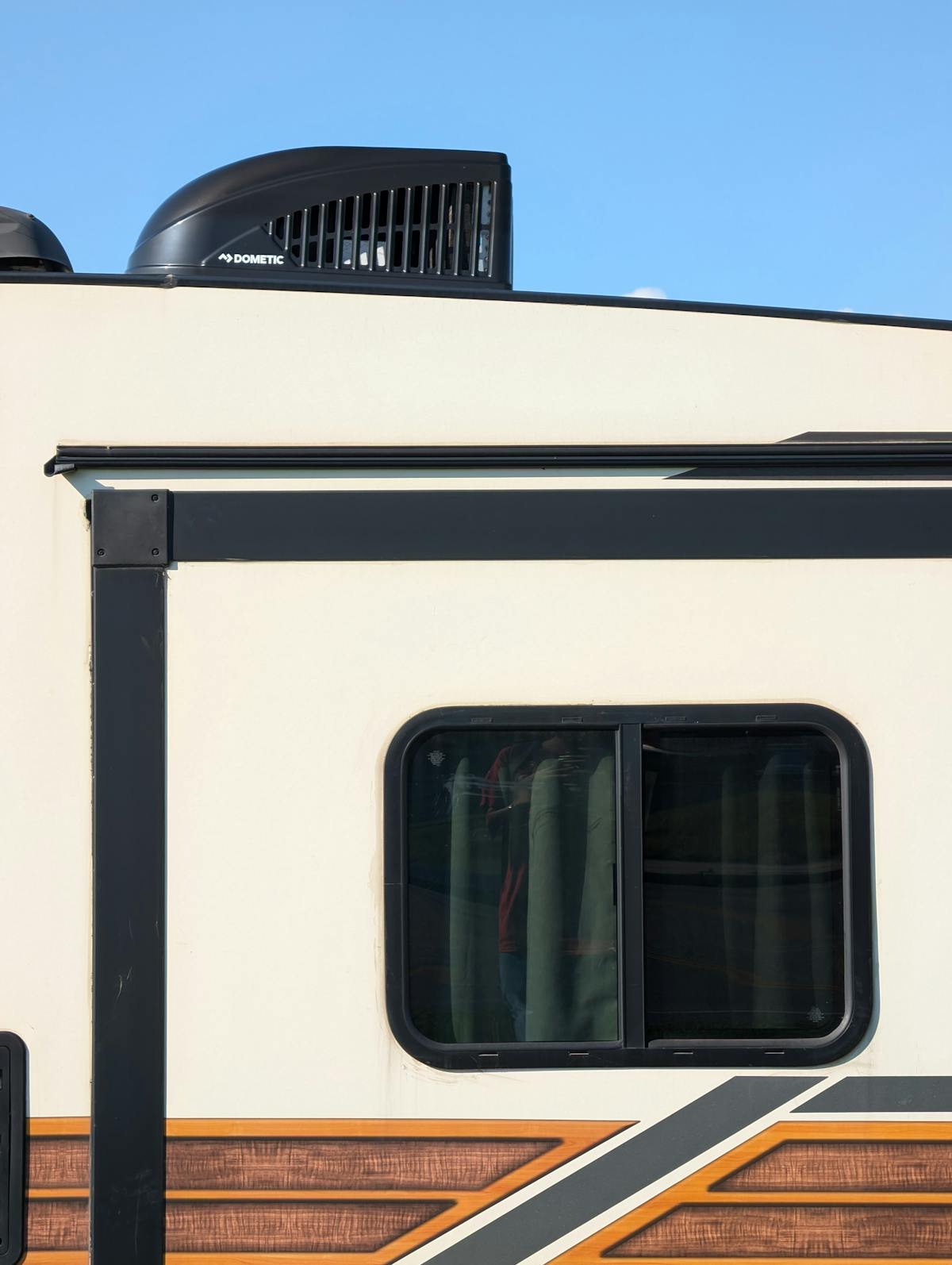
Step one before any seal maintenance: know what you have. Walk the exterior with a notebook (or, more usefully, a printed picture of the rig) and circle every penetration. You'll be surprised how many there are. Our Alliance has 47 distinct sealed features that we maintain on a schedule.
The categories you're looking for:
Roof penetrations
- Roof vents (kitchen, bathroom, bedroom).
- AC shrouds.
- Refrigerator vent stack.
- Furnace vent.
- Water heater exhaust (if vented up).
- Plumbing vent stacks.
- Solar panel mounts.
- TV antenna and satellite mounts.
- Skylights or sky-vents.
- Awning attachment points (sometimes through-bolted into the roof structure).
Sidewall penetrations
- Windows. Each window frame has a sealant run around it.
- Slide-out flange seals (the box's bond with the sidewall where the slide protrudes).
- Door frames (entry door, baggage doors, refrigerator access door).
- Exterior light fixtures (porch light, marker lights, brake/turn lights).
- Antenna mounts.
- Power cord access port.
- City water inlet.
- Black tank flush inlet.
- Cable/satellite inlet.
- Outside shower compartment.
- Awning attachment brackets on the sidewall.
- Slide-out topper brackets.
- Decals (the seam where decal meets gel coat sometimes traps water).
Front and rear cap features
- Cap-to-membrane joint along the top.
- Cap-to-sidewall joint along each side.
- Rear bumper attachments.
- Hitch attachment for fifth wheels (where the pin box meets the cap).
- Spare tire ladder attachment.
- Rear license plate light.
Underbody
- Sewer pipe penetrations through the belly skin.
- Furnace exhaust through the belly.
- Plumbing access panels.
- Tank access ports.
Once you have the map, take a picture and laminate it. Put it in your maintenance folder. Number each penetration. When you inspect, you'll mark each one as either good, watch, or needs reseal. The map turns "I should check the seals" into a finite, completable task.
The inspection cadence
Our rhythm, refined over five years:
Monthly: quick exterior walk-around
Five minutes. Eyes on every penetration as you walk past it. Anything obvious — peeling, cracked, dirty — gets noted. You're not climbing or kneeling; you're just looking. Most months turn up nothing.
Quarterly: hands-on roof and sidewall
An hour. Take a flashlight. Walk every roof penetration; push on sealant lightly to check for softness or detachment. Walk the sidewall and inspect the corners of every window, every flange, every fixture. Touch the seal. Look for hairline cracks at the corners.
Semi-annual: full inspection and resealing
This is the one. Twice a year, every year. Spring (before rainy season) and fall (before winter). Block a Saturday morning. Bring the map. Walk every penetration on your list and mark its condition. Reseal anything that's failed or is on the way out. We do ours in March and September; pick months that fit your climate but commit to twice a year.
If you only do one of these rhythms, do the semi-annual full inspection. The quarterly hands-on is a bonus.
The honest version
The quality of factory sealant work is, in our experience, wildly inconsistent unit to unit. Two rigs of the same model and year can have completely different sealant longevity depending on which line crew did the final sealing. This isn't a brand fingerprint; it's an industry one. Plan accordingly.
What "failed" actually looks like
Sealant doesn't all fail the same way. The categories of failure to watch for:
- Surface cracking. Hairline lines in the cured bead. Not always an immediate problem, but they propagate.
- Detachment. The bead has separated from the substrate on one side. Water enters between bead and surface.
- Discoloration. Yellowing, browning, or dark staining where the bead has absorbed moisture and is degrading.
- Softness. A finger press leaves an indent that doesn't recover. The chemistry has broken down and the bead has lost its elasticity.
- Voids. Bubbles, gaps, or missing sections in the original factory bead. Sometimes these have been there since day one.
- Sagging or running. Vertical sealant has crept down and exposed the upper edge of what it was sealing.
- Compromised butyl underneath. Hardest to spot from outside, but if a flange feels loose or the sealant on top has cracked all the way through, the butyl underneath is also suspect.
None of these have to mean rip-and-replace. Most are spot-resealable. A few — particularly compromised butyl under a flange — require removing the component, replacing the butyl, and re-bedding properly. That's an afternoon job at most for most penetrations.
The product matrix
Different products for different jobs. Using the wrong product is worse than waiting and using the right one.
Dicor self-leveling lap sealant (501LSW for EPDM, 551LSW for TPO)
The roof workhorse. Self-levels into a smooth, watertight bead on horizontal surfaces. Two distinct chemistries — make sure you grab the right tube for your roof material. EPDM and TPO products are not interchangeable.
Dicor non-sag lap sealant (501)
For vertical and sloped applications. Same chemistry family, formulated to stay where you put it.
ProFlex RV (Geocel)
A polymer sealant that does a few jobs well — flexible, paintable, sticks to most RV substrates including fiberglass, aluminum, EPDM, and TPO. We use it on sidewall penetrations and certain repair scenarios where flexibility matters. Not for horizontal roof beads where self-leveling is what you want.
Butyl tape
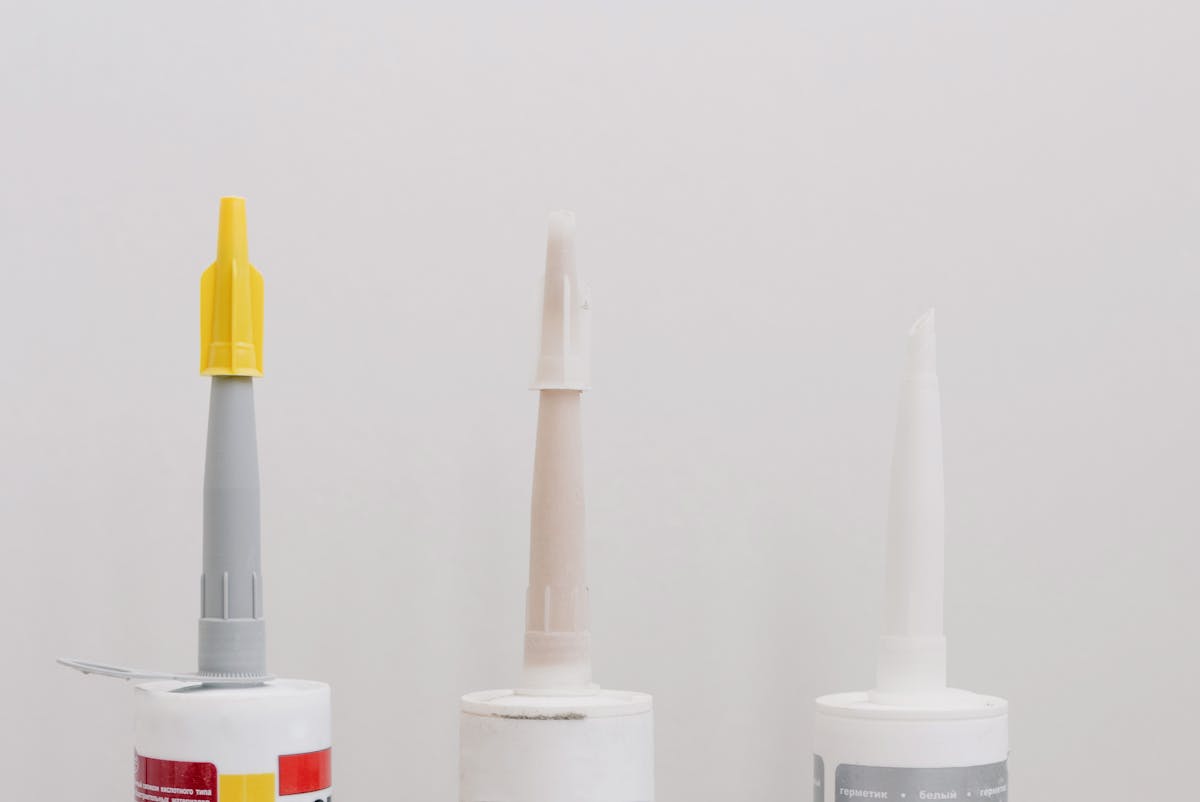
The primary seal under any component that gets screwed down — windows, vents, AC gaskets, exterior lights, water inlets, slide flanges. Butyl is putty-like, stays soft, and forms the actual water barrier. The lap sealant on top is the secondary seal that protects the butyl. Both layers matter.
When you remove and reinstall any component (which you do when a major reseal is in order), you replace the butyl. Don't reuse the old stuff. New butyl is a few dollars a roll and the difference between a working reseal and a future leak.
EternaBond tape
Acrylic adhesive tape, semi-permanent. Great for emergency repairs on the road. Great for seam reinforcement. Great for sealing the cap-to-membrane joint that's a known failure point on most rigs.
The catch: once it's down, it's down. Don't put it where you'll need to remove it later. Don't put it over a seam that someone might need to disassemble for service. Use it where you want permanent coverage.
Silicone caulk
No. Stop. Put it down. Silicone is one of the worst sealants for RV applications. It doesn't bond reliably to most RV substrates over time, it traps moisture against the surface underneath, and it makes future resealing difficult because nothing else sticks to where silicone has been. The hardware store kitchen-and-bath silicone has no place on an RV.
There is one exception: specifically formulated marine or RV silicone for narrow applications (some shower assemblies, some interior trim). Even then, it's a last resort.
Window tape (butyl putty tape)
A specific kind of butyl tape used between window frames and the wall opening. Some manufacturers use it under all windows. When you need to pull a window for resealing, this is the product you replace it with.
The resealing procedure
Spot reseal (most common):
- Wait for dry weather. Sealants need cure time.
- Clean the surface. Isopropyl alcohol wipe-down to remove dirt, oils, and any failed bead residue.
- Remove loose material. Plastic putty knife. Take off what's loose; don't try to strip down to substrate unless something is clearly wrong.
- Apply new bead. Even, steady. Slight overlap onto the surrounding intact sealant.
- Tool if needed. Self-leveling does its own job; non-sag sometimes wants a gloved finger to shape the bead.
- Cure time. Read the tube. Several hours minimum before rain or activity on the area.
- Log it. Date, location, product used.
Full component reseal (less common, more involved):
- Remove all sealant from around the component.
- Remove the screws.
- Carefully pry the component off (it's stuck to butyl). Plastic pry tools to avoid damaging the substrate.
- Scrape off all old butyl from both the component and the wall.
- Clean both surfaces with isopropyl alcohol.
- Apply fresh butyl tape to the component flange.
- Position and screw down. Tighten in a cross-pattern, evenly, until the butyl is properly compressed.
- Run lap sealant around the entire perimeter, on top of where the flange meets the wall.
- Tool as needed.
- Cure time.
- Log it.
Full reseals of major components — slide flanges, large rooftop components, complete window resealing — are at the edge of DIY scope for most owners. The procedure isn't exotic, but the consequences of getting it wrong (water intrusion behind the wall, structural rot) are significant. If you're not confident, this is a good "watch the tech do it the first time" job.
The "I think I have a leak" diagnosis
If you suspect a leak — water stain on a ceiling, soft spot in a wall, mildew smell that wasn't there last month — finding the source is harder than finding cracked sealant during a routine inspection. Water tracks. It enters at one point on the roof and surfaces six feet away on the ceiling. Or it enters at a slide flange and shows up as a soft spot in the floor.
A few diagnostic principles:
- Water travels downhill, but it follows the path of least resistance, not gravity. A stain on the ceiling might come from an entry point above and far away.
- Look for the highest point of staining. Water tracks down; the highest stain is closest to the entry point.
- Moisture meters are useful. A pinless moisture meter, $30–80, helps you map which parts of the wall or ceiling are wet.
- The garden-hose test. Have one person inside watching with a flashlight while another sprays water in a controlled pattern over suspected entry zones, working from low to high. Wait a few minutes between zones; water doesn't track instantly.
- NRVIA-certified inspectors have moisture meters, infrared cameras, and experience finding leaks that owners can't trace. NRVIA directory. Hiring one for a single inspection is sometimes the fastest path to an answer.
Once you've found the entry point, fix it properly — not just at the surface but at the underlying butyl if the failure is at a component flange. A surface-only fix on a deeper problem buys you a season at most.
The order of operations when something's gone wrong
If you find a real water-intrusion event:
- Stop the water entry. Tarp, EternaBond, emergency cover — whatever it takes to keep more from coming in until you can do a real repair.
- Dry the interior. Open the rig up. Fans, dehumidifiers, sunlight. Wet wood and insulation don't heal; they have to be either dried thoroughly or replaced.
- Inspect the damage. How far did the water travel? What does the wall feel like? Is there a soft spot in the decking?
- Decide DIY vs tech. Surface staining that dried out is one thing. Structural damage to studs, decking, or floor is a tech job — often a body-shop-level job — and an insurance call may be appropriate.
- Reseal the entry point properly. Don't just patch the surface. Pull the component, replace butyl, re-bed, re-sealant.
- Document. If this is warranty-eligible, you'll need photos, dates, and a written record. Our defect log post covers the procedure.
Don't trust the dealer's "they're sealed" claim
When you take delivery of a new RV, the dealer will often say the unit is "fully sealed" or "weather tight." That phrasing is not a service warranty; it's an inspection state. What's actually true is that some technician at some point ran a bead of sealant around all the penetrations, and the inspection happened at one moment in time. Heat, cold, transit vibration, and lot storage all affect those beads.
The first thing we recommend on every pre-purchase consult is a thorough sealant inspection of the entire exterior. Not just the roof — every penetration. We routinely find sealant defects on units that have never left the dealer lot. Sometimes the dealer addresses them; sometimes not. Either way, you want to know before you sign.
For used RVs, this matters even more. A used rig with seller-applied sealant on top of failing factory sealant is a deep red flag. Look for it. Multiple layers of sealant or visible silicone are tells that the rig has been "patched" rather than properly maintained.
The yearly seal kit
What we keep in the bin at all times:
- 2 tubes Dicor self-leveling (matched to roof type).
- 2 tubes Dicor non-sag.
- 1 tube ProFlex RV.
- 1 roll standard butyl tape.
- 1 roll window-specific butyl putty tape.
- 1 roll 4" EternaBond.
- Caulk gun.
- Plastic putty knives.
- Isopropyl alcohol and rags.
- Disposable gloves.
- Maintenance notebook.
Total cost: about $120 the first time you stock it. Replenish what you use each year. Compare to the cost of a single water-damage repair.
What this means for you
Map your penetrations. Set a spring-and-fall reminder. Buy the right products for the right surfaces. Walk every seam every six months with a flashlight. Reseal failures before they leak. Don't trust silicone. Don't trust "the dealer said it's sealed." If you discover real water intrusion, stop the entry first, dry second, repair third, document fourth. Hire an inspector if you can't find the source yourself.
RV sealant work is the most boring, repetitive, undramatic maintenance task in the calendar. It's also the one that decides whether your rig is structurally sound in year ten. The owners who keep their seams tight keep their rigs alive. The owners who don't have a story about a $12,000 ceiling repair that started with a $4 bead nobody checked.
Good Luck Out There!