
TL;DR
Dealers calculate trade-ins based on wholesale auction values plus reconditioning costs and a profit margin — typically 25-40% below what they'll resell the unit for. A private sale almost always nets you more money. Trade-ins make sense in three specific cases: you're underwater and the dealer is bundling the debt; your state offers meaningful trade-in tax savings; or you genuinely cannot face the time and effort of a private sale.
If there's a single line item on an RV purchase where buyers leave the most money on the table, it's the trade-in. The dealer offers a number, the buyer hears "free money I didn't have before," and the deal closes. What's actually happening is that the dealer is acquiring your unit at wholesale, prepping it for resale, and listing it for somewhere between $5,000 and $25,000 more than they gave you. That spread is real, and a meaningful chunk of it could have been in your pocket instead.
We've traded RVs twice and sold one private. The math hasn't been close. The private sale netted us roughly 30% more than we'd have gotten at trade, on a unit that was easier to sell than we expected because we priced it honestly and documented it thoroughly. This post is the framework that comes out of those experiences.
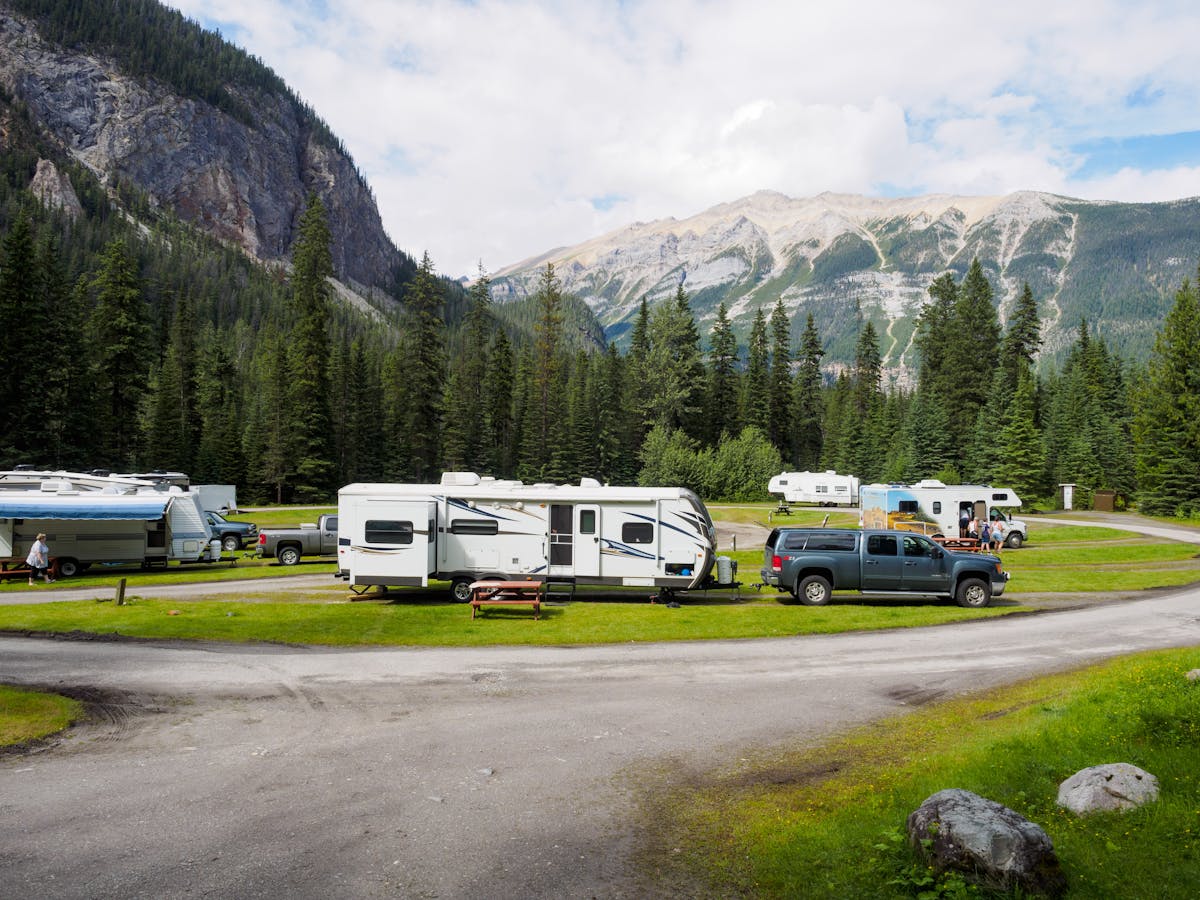
How a dealer actually calculates your trade
When the salesperson takes your keys and disappears for fifteen minutes, here's what they're doing:
- Looking up the wholesale value. They use NADA Guides, J.D. Power, or an internal valuation tool. They're looking at the "wholesale" or "trade-in" column, not the "retail" column.
- Adjusting for condition. They mark you down for cosmetic items, mechanical concerns, and anything they identify as "needs reconditioning."
- Estimating reconditioning costs. Roof reseal, tire replacement, cleaning, minor repairs, awning fabric — they tally what they'll spend to make your unit lot-ready and subtract it from their offer.
- Subtracting their target margin. Most dealers want $5,000-$15,000 of profit on a used unit. That margin is built into the offer.
- Comparing to current inventory. If they already have three of your floor plan on the lot, they'll go lower. If your unit is rare and in demand, they may go higher.
So the typical math, for a unit with a "retail" listed value of $40,000:
- Retail listing target: $40,000
- Wholesale book: ~$30,000
- Minus reconditioning estimate: -$1,500
- Minus target margin: -$6,000
- Their first offer: $22,500
Your unit will eventually retail for $38,000-$40,000 once it's on their lot. You got $22,500 for it. The spread is $15,500-$17,500. Some of that is real work and risk the dealer is taking on (reconditioning, holding cost, marketing, the possibility the unit takes six months to sell). Some of it is pure margin you could have captured by selling private.
Wholesale vs. retail: read the books yourself
Before you set foot in the dealership, look up your trade-in's value yourself. Two main sources:
- NADA RV Values — gives you "low retail," "average retail," and (for dealers, sometimes accessible) wholesale. The "average retail" is closer to what a private-party sale might fetch in average condition; "low retail" is closer to dealer wholesale.
- RVT.com and RV Trader — actual listings of comparable units, with asking prices. These are not transaction prices (the asking price is usually high), but they're a sanity check.
Also check completed sales on Facebook Marketplace if your area has active RV listings. Sold-listings data on RV-specific platforms is less available than for cars, but the active listings give you a workable estimate.
The number you should care about, going into a trade conversation, is the realistic private-party sale value of your unit. That's your alternative. The dealer's offer needs to compare favorably to that, accounting for your time and convenience preferences.
The trade-in tax savings myth (and the legitimate exception)
The most-quoted argument for trading instead of selling private is the sales tax savings. In some states, when you trade a vehicle, the sales tax on the new vehicle is calculated on the price minus the trade-in. So a $60,000 new RV with a $20,000 trade is taxed on $40,000 instead of $60,000. At a 6% rate, that's $1,200 in savings.
This is a real benefit — in the specific states where it applies. Several states do not offer trade-in tax credit on RVs (or on any vehicles). Some states cap the credit. Some states have specific rules about RV vs. motor vehicle classification that affect whether the credit applies.
What to do:
- Check your specific state's rules. Search "[your state] sales tax trade-in credit RV" or call your state's department of motor vehicles or revenue.
- Calculate the actual tax savings in dollars. On a typical purchase, it's $1,000-$3,000.
- Compare that savings to the gap between trade offer and private-party sale value. If the private-party premium is $5,000 and the tax savings is $1,500, private-party still wins by $3,500.
Trade-in tax savings is real but rarely large enough to override a meaningful private-party premium. The dealer will talk about it as if it were a windfall. It's not — it's a state-specific line item.
The honest version
If a salesperson tells you "you'll save thousands in taxes by trading," ask them for the math, written out, with your specific numbers and your specific state's rules. The math usually shows up smaller than the pitch.
When trade-in actually beats private sale
For all the math above, there are situations where the trade-in is genuinely the better choice. We don't want to pretend otherwise.
You're underwater on the current loan
If you owe more on your current RV than it's worth — common in the early years of a 20-year loan — selling private requires you to bring a check to closing for the difference. Most private buyers won't navigate this. A dealer, on the other hand, can simply roll the negative equity into your new loan. This is financially terrible in the long run (you're now financing two RVs' worth of negative equity), but it's also the only practical exit if you can't bring cash to the table.
We'd argue that if you're underwater, the right move is often to keep the current rig until you're no longer underwater — but life doesn't always permit that. If you must trade out, at least understand that the "trade" is functionally a debt-rollover, and the new loan is going to be larger than the new RV is worth on day one. See our financing traps post for the long-term implications.
The state tax savings is meaningful in your state
If you're in a state with a generous trade-in credit and a high sales tax rate, the math can flip. Texas, for example, allows trade-in credit on motor-vehicle-style RVs at 6.25%, which can move a couple thousand dollars. Other states are similar. Run the numbers.
You genuinely cannot do a private sale
Some people are not going to enjoy fielding tire-kickers, hosting test drives, dealing with title transfers, and managing the safety logistics of meeting strangers with cashier's checks. That's a real cost in time and stress. If you'd rather pay $4,000-$8,000 for the convenience of avoiding all that, the trade-in is a service you're paying for. We won't pretend it's free, but we also won't pretend it's worthless.
The dealer offers wholesale-plus
Occasionally — usually on a unit the dealer specifically wants — they'll offer above wholesale. This happens when:
- Your unit is a desirable floor plan they don't currently stock.
- The market for that specific brand and year is hot.
- They have a buyer already lined up.
- They need to hit volume to secure a manufacturer rebate.
When this happens, the trade offer can approach or even meet private-party value. It's not common, but it's worth letting the dealer make the offer before assuming trade is bad.
The two-offer trick: how to make a trade competitive
Even when you suspect private sale is the right answer, soliciting multiple trade offers serves two purposes: it gives you negotiating leverage, and it occasionally surprises you.
Three places to get trade quotes:
- The dealer you're buying from. Standard.
- One or two other dealers, ideally of the same brand, in your region.
- Wholesale buyers — companies that specifically purchase RVs for resale or auction, advertised online. Their offers are usually lower than dealer trade offers, but they tell you the absolute floor on the unit's value. If a wholesale buyer offers $18,000 and a dealer offers $20,000, the dealer offer is essentially "wholesale plus $2,000."
The cleanest version of this exercise: get three offers in writing, with at least 7-day validity, before walking into the dealership where you intend to buy. The dealer can match or beat them, but they can't beat what they don't know about.
How to maximize a private sale (when you go that route)
If you decide to sell private, here's how to net the most:
Clean it
A unit that's been detailed photographs better, shows better, and sells faster. Spend $200 on a thorough exterior wash, wax, interior shampoo, and minor cosmetic fixes. This easily pays for itself in faster sale and higher offers.
Document everything
Buyers of used RVs are nervous. The more documentation you can provide, the more confident they'll be:
- Service records, ideally organized chronologically.
- Receipts for major maintenance (roof reseal, tire replacement, generator service).
- The original sales paperwork.
- The owner's manuals and component documentation.
- Photos of the roof and underbelly.
- Generator hour readings and slide cycle counts if available.
Photograph it well
Daylight, no clutter, all the slides extended, all systems on, both interior and exterior. 20-30 quality photos. We've watched RVs sell faster with great photos than with marginally better pricing. The photos are the listing.
Price honestly
Look at comparable active listings, comparable sold listings (where available), and the NADA range. Price 5-10% above your bottom-line acceptance number — enough room to negotiate without overpricing yourself out of the search results.
Be transparent about issues
If your unit has known problems, disclose them in the listing. Counterintuitively, this generates better-quality leads than hiding them. Buyers who appreciate honesty up front are also the buyers least likely to back out at the last minute over something they discover at the test-drive.
Be careful about how you handle payment
Cash, cashier's check verified at the issuing bank, or a documented wire transfer. No personal checks. No "I'll pay you when I get home." This is the part most likely to go wrong if you're not careful. If you're not comfortable handling the transaction yourself, many states allow escrow through a title company for a few hundred dollars.

The "trade-up trap"
A specific pattern worth flagging: dealers love to advertise "trade-up events" where they encourage current owners to trade their existing unit toward a newer model with "no money down" and "your same monthly payment." Sometimes this is structured as a manufacturer-supported promotion.
The math, if you look closely, almost always involves rolling negative equity from the current loan into the new loan, extending the new loan to 20+ years, and selling you a more expensive unit. The "same monthly payment" comes from the longer term and the bigger loan offsetting the higher price. The total cost of ownership goes up substantially.
This is not always a bad deal — sometimes a family genuinely needs a different floor plan and the trade-up is the cleanest path to it. But evaluate the underlying numbers, not the monthly payment. Run the math the same way you would for a fresh purchase. See financing traps for the full discussion.
What about consignment?
Some dealers offer to sell your unit on consignment — they handle the listing, showings, and sale, taking a percentage (typically 8-15% of the sale price). This is a middle path between trade-in and private sale.
Pros:
- You usually net more than a trade-in.
- You don't deal with strangers, test drives, or title paperwork.
- The unit is on display alongside other RVs, generating qualified-buyer traffic.
Cons:
- You typically net less than a private sale.
- The unit may sit for months while the dealer prioritizes their own inventory.
- The contract usually requires you to leave the unit on the lot for a defined period during which you can't sell it elsewhere.
- Some consignment dealers charge "prep fees" or "storage fees" that erode your net.
Consignment works best for people who have a relatively desirable unit, don't need the cash urgently, and value not handling the transaction themselves. Read the consignment contract carefully — particularly the cancellation terms.
The negotiation, in practice
When you get to the dealer and trade-in talk starts, here's a sequence that tends to work:
- Establish the out-the-door price of the new RV first, before discussing the trade. Don't let them bundle the two conversations.
- Once the new RV price is set in writing, ask: "What can you give me for my trade?"
- Whatever number they offer, ask: "How did you calculate that?" Listen to the answer. Take notes.
- Show them your private-party valuation. "I see comparable units listed at $X. My wholesale book value is $Y. Your offer is below both."
- Ask them to walk you through the reconditioning estimate. If specific items they're charging you for ($800 for a roof reseal, $400 for tires) don't reflect your unit's actual condition, push back.
- If the gap remains significant, tell them you'll consider it and explore private-sale options. Mean it. Walk to your truck.
- The number sometimes improves over the next 24-48 hours. If it doesn't, list privately.
What this means for you
Your current RV is worth more than the dealer wants to pay for it, and more than you probably think. Don't give it away in a fog of excitement about the next unit. Look up the wholesale value, look up the private-party value, get multiple offers, and decide on the basis of dollars and time, not on the convenience of doing it all at once.
If the trade math works in your state and your situation, fine. If it doesn't, the private sale or consignment paths exist and they consistently put more money in your pocket. The work is real but bounded — most well-prepared private sales close within 4-8 weeks. Two months of patience is often worth $5,000 to $10,000.
If you'd like help running the actual math on your specific trade-in versus private sale, that's part of what pre-purchase consulting covers. Until then: look up your own number, get it in writing, and as always: Good Luck Out There!